
Bitcoin Academy: Part 5
Recap
In Part 1, we explored the innovations and events that led to Bitcoin’s invention. We saw how centuries of monetary evolution, the rise of the internet, and breakthroughs in cryptography set the stage for Satoshi Nakamoto’s creation–all catalyzed by the 2008 financial crisis. This context explained why Bitcoin was invented: to be “a system where rules are enforced by code, not institutions,” addressing issues like centralized control of money and the lack of trustless online payments.
In Parts 2, 3, and 4, we looked under the hood at how Bitcoin works. We broke Bitcoin into three layers (the network, the protocol, and the asset) to understand how it operates as a trustless, decentralized system. We saw that a global network of nodes and miners keeps the ledger consistent, the protocol’s rules (like proof-of-work mining and a 21 million supply cap) act as Bitcoin’s unchangeable “constitution,” and the bitcoin asset itself functions as a new form of sound money. At this point, we understood the technical foundations that make Bitcoin possible.
In Part 5, we step back from the technical details to examine Bitcoin’s living history and its future prospects. To make sense of Bitcoin’s journey, we’ll use a metaphor: Bitcoin as a developing nation. Despite being a decentralized software network, Bitcoin has evolved much like a young nation finding its footing. We’ll examine four key pillars of this metaphor:
1. Domestic Governance
2. National Defense
3. Foreign Policy
4. Economic Development
We’ll highlight major events, ranging from the “Blocksize Wars” to Bitcoin crossing $100K. Finally, we’ll see how technical concepts translate into real-world impacts and how Bitcoin matured from a fledgling experiment into a robust player on the world stage. Let’s dive in.
Domestic Governance: Bitcoin’s Internal Rule of Law
Every nation needs a system of governance–a way to make decisions and enforce rules. Bitcoin’s “domestic governance” is unlike any traditional nation’s; there’s no president or parliament, only a community of users, miners, and developers spread across the globe. In Bitcoin, the rules were initially set in code by its creator, Satoshi, and then left to the community when Satoshi disappeared in 2010. Changes to Bitcoin’s rules require overwhelming consensus. In fact, altering Bitcoin is so difficult that it’s often said the protocol has a constitution etched in code. This design protects Bitcoin from whim or corruption; no single group can easily push through changes. But it also means that internal governance can be slow and contentious. One dramatic test of Bitcoin’s governance was the Blocksize Wars.
The Blocksize Wars
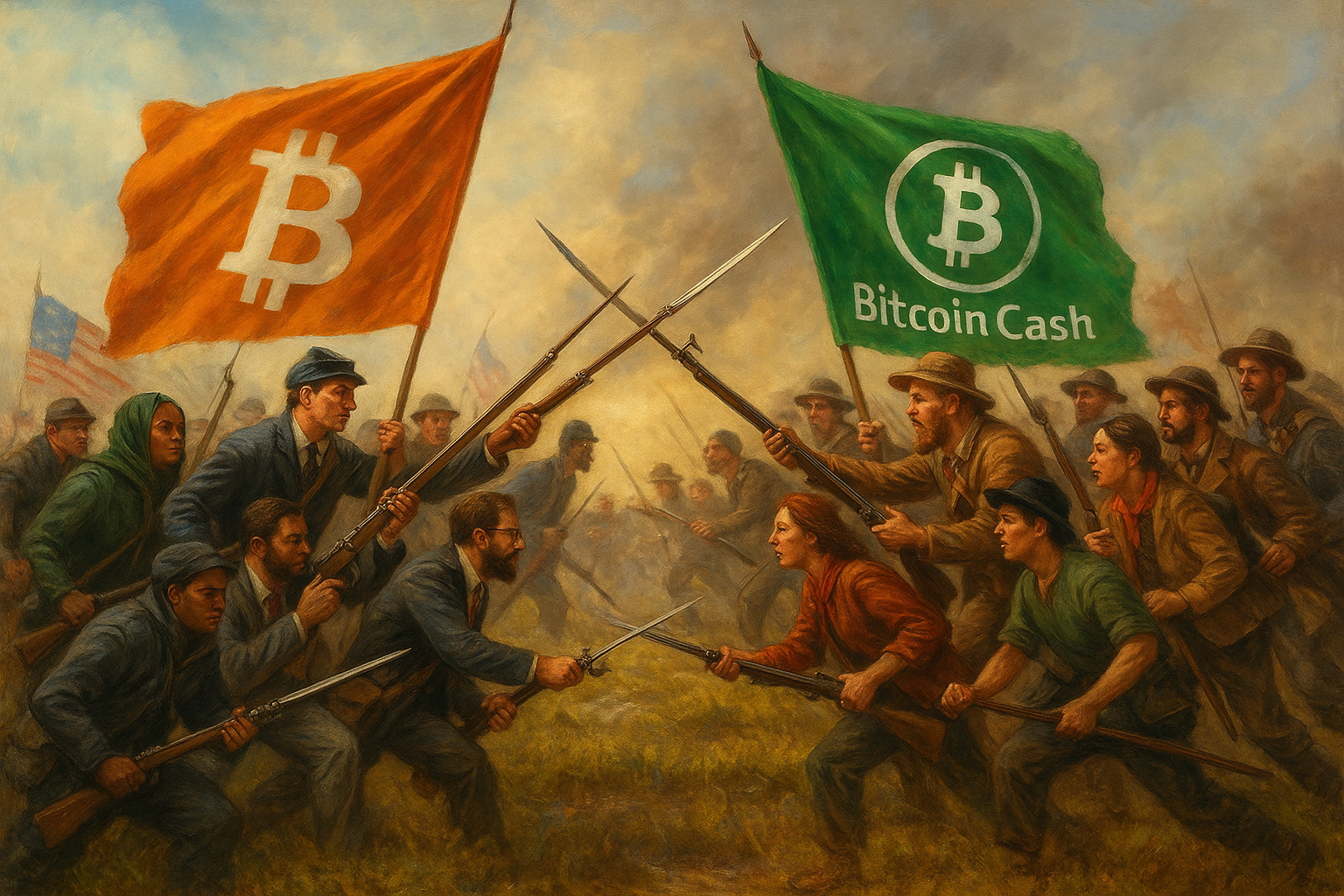
As Bitcoin’s usage increased, debates over how to scale the network intensified. The central issue was the block-size limit, which controls how many transactions each block can carry. One camp (“Big Blockers”) argued for larger blocks to fit more transactions, aiming to lower fees and improve speed for a better user experience. The other camp (“Small Blockers”) insisted on keeping blocks small to ensure anyone could run a node and keep the system decentralized. This ideological rift led to heated arguments in forums and conferences, competing proposals, and even threats of splitting the network. It was a kind of constitutional crisis for Bitcoin. Bitcoiners asked themselves: How would we decide on a major policy change without a central authority?
The showdown culminated in 2017\. A portion of the community chose to “fork” away, creating a new version of the protocol with bigger blocks (this fork became known as Bitcoin Cash). Meanwhile, on Bitcoin’s main chain, a more conservative scaling upgrade called Segregated Witness (SegWit) was activated, which gained consensus and improved capacity without increasing block size. In effect, Bitcoin’s community split over governance: those unhappy with the status quo left to pursue their vision with Bitcoin Cash, while the majority agreed on the gradual solution of SegWit. It was a civil war in code, and SegWit ultimately emerged as the winner.
Bitcoin did not increase its block size, and Bitcoin Cash became largely irrelevant, suffering from dismal liquidity, low developer activity, and minimal adoption. The episode proved that Bitcoin’s core rules can’t be changed easily. Any change needs near‑unanimous agreement; otherwise, dissenters will simply fork off. This resilience against change was by design, to protect the system from central control, but it came at the cost of bitter division and delayed adoption. Yet, out of this conflict came a silver lining: an affirmation of Bitcoin’s values. The community by and large chose decentralization and security over quick expansion, and it doubled down on scaling via innovation (like the Lightning Network) rather than altering the base layer. Governance by consensus prevailed, messy as it was.
The Taproot Upgrade (2021): A Quiet, Consensus‑Driven Fork
Four years later, Bitcoin underwent another major upgrade, Taproot, activated in November 2021. Politically, it was the opposite of the Blocksize Wars:
* Broad alignment on objectives. Taproot did not revisit Bitcoin’s ideological fault lines (decentralization vs. throughput). Instead, it offered “no‑losers” improvements: better privacy and lower transaction overhead without any trade‑off that threatened node accessibility or monetary policy.
* Incremental, well‑tested code. Development spanned years of peer review and testnet trials. Because the change was additive rather than disruptive, node operators could adopt it at their own pace without breaking old wallets or forcing a hard choice.
* Transparent activation rules. The community agreed on a clear signaling method requiring \~90% of miner computing power (hash rate) to show support over a fixed period. The explicit, objective threshold meant everyone knew the rules in advance and accepted the outcome.
* Optional opt‑in. Nodes that never upgraded remained fully compatible; they simply could not spend Taproot‑style outputs. By making the feature purely additive, dissenters were not pushed toward a contentious split.
The result: miners hit the threshold early, activation was automatic, and hardly anyone noticed a “fork day.” Where the Blocksize Wars resembled a national schism, Taproot felt like passing a bipartisan amendment.
Bringing It All Together
Bitcoin’s internal governance has kept it decentralized and stable. Even through fierce debates like the Blocksize Wars, no single group could force changes on everyone else–changes only happen through widespread consensus or not at all. Taproot showed that, given clear benefits and transparent procedures, the same decentralized system can still evolve smoothly. The Bitcoin community learned two valuable governance lessons:
1. Guard the constitution, but allow additive innovation. Core principles (such as 21 million supply and full node sovereignty) will likely stay nearly untouchable; non‑core improvements succeed when they are strictly opt‑in and demonstrably low‑risk.
2. Publish the rules of decision‑making before the vote. The Taproot upgrade illustrated how setting an objective threshold and timeline in advance builds trust, avoids ambiguity, and minimizes post‑decision resentment.
Slow, open‑source consensus may feel cumbersome, yet it creates a durable “rule of law” atmosphere in which nodes voluntarily comply and innovators still find room to build. That combination (constitutional rigidity plus permissionless, opt‑in progress) is the governance balance Bitcoin has learned to strike.
Of course, setting up internal rules is only half the story for a budding nation. The next challenge was defending Bitcoin’s network and community against threats–from hackers to hostile powers. Like any nation, Bitcoin had to survive attacks to prove its resilience.
National Defense: Resilience in the Face of Crises
If Bitcoin is a digital nation, its “national defense” is the security of its network and the protection of its users’ assets. Bitcoin doesn’t have an army, but it has miners and nodes working to secure the blockchain. The proof-of-work mechanism is often likened to a fortress: attackers would need extraordinary resources (51% of the network’s hashing power) to rewrite or fake transactions, making attacks economically and technically infeasible in practice. However, in Bitcoin’s early years, many wondered: could this really withstand real-world assaults? Over the past decade, Bitcoin has faced numerous crises that tested its defenses. Each time, it emerged stronger. One of the earliest major blows came from within the ecosystem rather than the protocol itself: the infamous Mt. Gox exchange hack.
Mt. Gox Hack

Mt. Gox was the largest Bitcoin exchange at the time–handling roughly 70% of all Bitcoin trades–until it was revealed that hundreds of thousands of bitcoin had been stolen from it. In early 2014, Mt. Gox collapsed into bankruptcy, taking down its users’ funds and sending shockwaves through the young Bitcoin economy. The price of bitcoin, which had soared to around $1,000 in late 2013, plummeted by over 80% in the aftermath.
For many, this was the first time Bitcoin “died” in the headlines. Was the network hacked? No. The problem wasn’t with Bitcoin itself but with Mt. Gox, a major exchange that mishandled user funds and had weak security practices. The Mt. Gox incident was a harsh lesson in security: it taught the community the importance of safeguarding private keys and led to the mantra “Not your keys, not your coins.”
In terms of our metaphor, this hack was a coordinated act of economic espionage. It tested national morale severely. However, Bitcoin’s defense lay in its decentralization: despite the collapse of a huge intermediary, the Bitcoin network itself kept running. Blocks were mined on schedule; no coin was counterfeited or “lost” on the blockchain. Bitcoin survived the crisis and continued to attract new exchanges and users, proving its antifragility. As painful as it was, the ecosystem emerged with stronger exchanges, better security standards, and a wary eye toward single points of failure. The “Bitcoin nation” learned that it could endure a disaster and rebuild.
External attacks on the network have come as well, sometimes from powerful institutions. A striking example was China’s ban on Bitcoin mining in 2021\.
China’s Bitcoin Mining Ban
In 2021, China conducted a state-driven attack on a huge chunk of Bitcoin’s hash power. For years, China had been home to a majority of Bitcoin mining operations. Suddenly, in mid-2021, the Chinese government outlawed mining, forcing miners to shut down or flee overseas. The impact was immediate: within weeks, Bitcoin’s total network hash rate (computing power) dropped by roughly 50%, the largest decline in history. It was as if half of Bitcoin’s defensive army vanished overnight–a pivotal test of the network’s resilience. And yet, Bitcoin handled it exactly as designed: the protocol didn’t panic, it adjusted. Every two weeks, the network automatically recalibrates its mining difficulty based on the current hash power. So, after China’s ban, Bitcoin made mining easier, ensuring that remaining miners could continue finding blocks at roughly the same 10-minute intervals. Meanwhile, displaced miners started a “great mining migration,” relocating to countries like the United States, Kazakhstan, and Russia.
Within a few months, the hash rate not only recovered but hit new all-time highs as mining became more geographically distributed than ever. By 2022, the U.S. had become the largest hub for Bitcoin mining, filling the gap left by China. The ban, intended to weaken Bitcoin, arguably ended up strengthening it by dispersing its security base across more jurisdictions. This episode demonstrated Bitcoin’s national defense in action: a blend of game theory and adaptive technology. The economic incentives of mining pulled miners back online, and the protocol’s rules kept the system secure even under distress. It was as if a developing nation faced sanctions from a superpower and, after a brief hardship, found a way to become more self-reliant and resilient than before.
Beyond these headline events, Bitcoin’s network has thwarted countless smaller attacks and bugs. There have been attempts at DDoS attacks (flooding the network with spam transactions), speculative worries about one miner gaining 51% control, and even a couple of software bugs that could have been catastrophic had they not been quickly fixed by developers. Each time, the open-source community of developers and node operators acted as a volunteer corps of “engineers” strengthening the fortifications. The result, after 16 years, is that Bitcoin has never been successfully hacked at the protocol level. This track record is an enormous source of confidence. It’s why we now see institutions comfortable investing billions into Bitcoin–because its security has been battle-tested.
Bringing It All Together
Through crisis after crisis, Bitcoin has proven its robustness. Whether it was an exchange implosion like Mt. Gox or a nation-state crackdown on mining, the Bitcoin network survived intact and came back stronger. Its decentralized design–from mining to node governance–is a powerful defense mechanism. For users, the lesson is that Bitcoin is resilient but not infallible: individual companies or players may fail, but the network as a whole is engineered to withstand attacks and adapt. This resilience underpins trust in Bitcoin as a lasting system.
Having survived internal strife and external attacks, Bitcoin’s “nation” next had to navigate its relationship with the outside world. How would it interact with traditional nations, laws, and global markets? This brings us to Bitcoin’s foreign policy.
Foreign Policy: Bitcoin’s Relationship with the World
No nation exists in isolation. Bitcoin’s “foreign policy” refers to how it engages with governments, regulators, financial institutions, and global public opinion. In its early years, Bitcoin was like a renegade micro-nation unrecognized by others–used by a niche group of citizens, sometimes for activities that attracted negative attention. Over time, as Bitcoin grew, so did the world’s interest in it. This has been a journey from marginalization to gradual acceptance, marked by legal battles, regulatory milestones, and even adoption by nation-states.
Eastern Opposition, Western Détente
In the beginning, many authorities simply didn’t know what to make of Bitcoin. Some ignored it, while others associated it with crime. Several high-profile events gave it a Wild West image, most notably the Silk Road marketplace (an online black market in the early 2010s where Bitcoin was used for illicit purchases) and other incidents on the dark web. When the U.S. government shut down Silk Road in 2013 and seized a large stash of bitcoin, it sent a message that law enforcement was watching crypto. Yet, tellingly, even after Silk Road was gone, Bitcoin was still there. This was a new situation for governments: normally, shutting down a criminal enterprise would also eliminate its “currency,” but they couldn’t shut down Bitcoin itself. That resiliency started to shift perceptions. By the mid-2010s, regulators worldwide moved from outright hostility or indifference to trying to establish rules for cryptocurrencies.
A watershed moment in Bitcoin’s global standing came in 2017\. In September of that year, China dramatically banned domestic Bitcoin exchanges and initial coin offerings (ICOs). At the same time, Western regulators began to step in. They did not seek to ban Bitcoin; instead, they worked to integrate it into existing legal frameworks, for example, by classifying it as property for tax purposes and requiring exchanges to follow anti-money-laundering rules. The late 2010s established a new kind of detente: most major economies didn’t outlaw Bitcoin, but they didn’t fully accept it either. Bitcoin was now on the agenda in legislative halls and regulatory agencies. The “Bitcoin nation” had gained a voice in international dialogue, albeit one that was often controversial.
Perhaps the most remarkable development in Bitcoin’s foreign relations was nation-state adoption.
El Salvador Adoption as Legal Tender
In 2021, El Salvador became the first country in the world to recognize Bitcoin as legal tender. This tiny Central American nation essentially made Bitcoin an official currency alongside the US dollar. The news shocked and fascinated the world. For Bitcoin’s advocates, it was a triumphant moment: the first diplomatic recognition of Bitcoin by a sovereign nation, akin to an upstart country gaining its first ally. El Salvador’s government touted Bitcoin as a way to empower citizens without bank access and reduce fees on remittances (a huge portion of El Salvador’s GDP comes from money sent home by Salvadorans abroad). But the move also drew criticism and warnings. The International Monetary Fund and World Bank frowned on it, and some Salvadorans protested the volatility and uncertainty this new foreign currency brought. Nonetheless, El Salvador’s bold experiment signaled that Bitcoin’s influence had grown beyond tech circles; it was now part of geopolitical conversations. While El Salvador remains unique in full legal tender status, the mere fact that a national government would hold bitcoin in its treasury and mandate its acceptance marked a new chapter in Bitcoin’s foreign policy: Bitcoin as an ally, not an enemy, of nations.
Meanwhile, in countries with established financial systems, Bitcoin’s relationship with regulators has continued to mature, albeit slowly and contentiously. A prime example is the battle over a Bitcoin exchange-traded fund (ETF) in the United States.
Grayscale Investments, LLC v. SEC

For years, the U.S. Securities and Exchange Commission (SEC) blocked proposals to create a regulated spot Bitcoin ETF (which would let mainstream investors gain Bitcoin exposure through the stock market). Grayscale’s lawsuit against the SEC became a pivotal showdown. Grayscale, which operated the largest Bitcoin trust, sued the SEC in 2022 for rejecting its application to convert its trust into an ETF. In August 2023, a U.S. appeals court delivered a landmark ruling: it found the SEC’s rejection was “arbitrary” and unjustified, since the SEC had already approved Bitcoin futures-based ETFs but not a spot ETF. This court victory forced the SEC to reconsider and was celebrated as a major win for the crypto industry’s push into traditional finance.
By late 2023, the SEC signaled it would not appeal the decision, paving the way for the first U.S. spot Bitcoin ETF to eventually be approved. In diplomatic terms, this was like Bitcoin winning recognition from a powerful international body. An ETF means wider access and legitimacy, bringing Bitcoin further into the fold of the global financial system. Similarly, large institutions (from Fidelity to BlackRock) began lining up to launch Bitcoin investment products, another sign that engagement has replaced denial. Today, even governments are much more openly discussing how to accommodate Bitcoin.
Bringing It All Together
Bitcoin’s foreign policy can sometimes feel like one step forward, one step back: a major bank announces a Bitcoin service, but then a regulator issues a stern warning or new restriction. Through it all, Bitcoin’s strategy has been one of persistence. It doesn’t have a President or CEO to testify or negotiate; instead, its “ambassadors” are its community and market forces. As more people and businesses adopt Bitcoin, the more pressure builds on policymakers to incorporate it rather than prohibit it. In fact, many observers note that Bitcoin’s spread has made a blanket ban in liberal democracies increasingly unlikely–too many constituents now own it. This gradual normalization is akin to a once-isolated nation gaining trading partners and diplomatic ties because its citizens and products became desirable abroad.
Bitcoin is increasingly being treated not as an enemy of the state, but as a new player that states and institutions must learn to work with (or even leverage). The “Bitcoin nation” is carving out its place in the global order, one relationship at a time.
Finally, no nation is complete without an economy. How has Bitcoin built out its economic might? We’ll look at Bitcoin’s economic development: the booms, busts, and growth of its financial ecosystem.
Economic Development: From Quirky Experiment to Thriving Economy
The economic development of Bitcoin is perhaps the most striking storyline. We’re talking about value: the market capitalization of Bitcoin, the industries and jobs created around it, and the financial infrastructure built on top. It’s hard to overstate how far Bitcoin’s economy has come since its inception. What began as a handful of enthusiasts trading bitcoin for pennies has become a global market where billions of dollars change hands daily. Bitcoin’s price (an easy if imperfect measure of economic growth) went from nearly zero in 2009 to breaching five and even six figures. In fact, in late 2024, Bitcoin’s price crossed the $100,000 mark for the first time in history, pushing its total market value above $2 trillion. This milestone, once thought crazy, underlined how a decentralized digital economy had established itself as a force to be reckoned with. Let’s recap this economic journey and what it means functionally and culturally.
Early economy (2009–2013)
In Bitcoin’s first years, its “GDP” was tiny and its economy rudimentary. There were no reliable exchanges at first. People swapped bitcoin on forums or via quirky marketplaces. The first exchange rates valued Bitcoin at fractions of a penny. The community was small, composed mostly of programmers and libertarians who saw Bitcoin as either an experiment or a haven from the traditional financial system. By 2013, Bitcoin had its first big bubble–surging over $1,000–which, despite the subsequent crash, put this new economy on the global map. People started to realize something of value was being created here.
Growth and industry formation (2014–2017)
After the bear market of 2014-2015, Bitcoin’s economy entered a more mature growth stage. New exchanges emerged (Coinbase, Bitstamp, and Kraken) with better security and venture capital backing. Industry segments formed: mining became a big business with specialized hardware manufacturers and mining farm operators; “wallet” companies were founded to provide easier ways for users to hold bitcoin; and a growing investor class started treating Bitcoin as “digital gold,” a store of value investment. By 2017, Bitcoin’s economic clout was far greater than a few years prior. That year saw an unprecedented influx of retail investors worldwide, driving the price from under $1,000 in January to nearly $20,000 by December. At the height of that bubble, the world started hearing about Bitcoin on nightly news and social media. Importantly, even when the bubble popped in early 2018 and the price fell \~80% again, the floor was much higher than in 2014\. More capital stayed in the system, and crucially, infrastructure kept improving.
Mainstream integration (2018–2021)
The next phase saw Bitcoin stepping onto the big stage. By now, it had a place in the portfolios of not just cypherpunks, but also hedge funds and some forward-thinking institutions. A few landmark events drove this integration. In 2020, amidst the COVID-19 pandemic economic turmoil, several public companies decided to allocate some of their cash reserves to Bitcoin–MicroStrategy famously bought hundreds of millions in bitcoin as a treasury reserve, and Tesla followed by purchasing $1.5 billion worth of Bitcoin in early 2021\. These moves were validation that Bitcoin was becoming a legitimate asset class. Around the same time, PayPal and other payment companies announced support for buying and spending crypto, vastly expanding access. The culmination was another explosive bull market in 2021: Bitcoin’s price hit a new peak of \~$69,000 in November 2021, and the market cap of Bitcoin alone neared $1.3 trillion. During this period, the first Bitcoin futures ETF launched in the U.S. (allowing indirect investment via traditional markets), and large banks began offering crypto custody services for clients. Culturally, Bitcoin was now regularly compared to gold as an inflation hedge; it had entered discussions about macroeconomic strategy in an era of heavy money printing by central banks. In our nation metaphor, Bitcoin’s economy was now acknowledged by “global financial institutions” –analogous to an emerging market being noticed by the IMF or being added to world economic indices.
Bitcoin breaks $100K and beyond (2022–2025)
Breaking six figures is symbolic. It reflects roughly a decade and a half of compounding growth and adoption. At $100K, the total economic size of Bitcoin was about $2 trillion, rivaling the GDP of medium-sized countries or the market cap of the largest companies on earth. Such a valuation wasn’t driven purely by retail speculation; it was underpinned by institutional investment, global usage, and the narrative of digital gold solidifying as inflation globally remained a concern. By this time, the Bitcoin economy included a wide web of services: millions of merchants accepting bitcoin via Lightning Network, Bitcoin ATMs in cities worldwide, a derivatives market for bitcoin futures/options, and even Bitcoin-backed loans and financial products. Bitcoin finally became financially integrated. You could hold it in your retirement account, use it to send money abroad instantly, or borrow against it.
Wrap Up
In 2025, the Bitcoin “developing nation” is far more developed now: it has a currency recognized and held by millions, a global trade network, and even a budding sense of nation-state identity. Bitcoin’s economic development has been extraordinary–from virtually zero value to a multitrillion-dollar asset class in 15 years. This growth was fueled by a series of boom-and-bust cycles that each expanded Bitcoin’s infrastructure and adoption. The key point is that Bitcoin is much more than an idea now. It’s a robust, functioning economy. Understanding Bitcoin means appreciating that it has an economy that behaves in some ways like a nation’s economy, with its own trends, industries, and innovations driving it forward.
Part 6 is the last entry in the Bitcoin Academy series. In it, we’ll share our firm’s perspective on Bitcoin and our view on the technology’s staying power.