Bitcoin Academy: Part 4
With the network explained in Part 2, and the protocol rules covered in Part 3, we now turn to the thing the system actually moves: bitcoin the asset.
Bitcoin as an Asset: The “Digital Gold” Cryptocurrency
What makes Bitcoin “money” rather than just a ledger of IOUs? It’s the fact that bitcoin themselves are valuable units that can be exchanged. In other words, bitcoin is also a currency. But unlike fiat money (dollars, euros, etc.) which are issued by central banks, Bitcoin’s currency has a strict, algorithmically enforced monetary policy. This was a deliberate design choice by Satoshi, inspired by the flaws he saw in traditional money systems (like inflation and money printing—problems highlighted in Part 1).
Bitcoin has a supply limit and programmatic issuance schedule
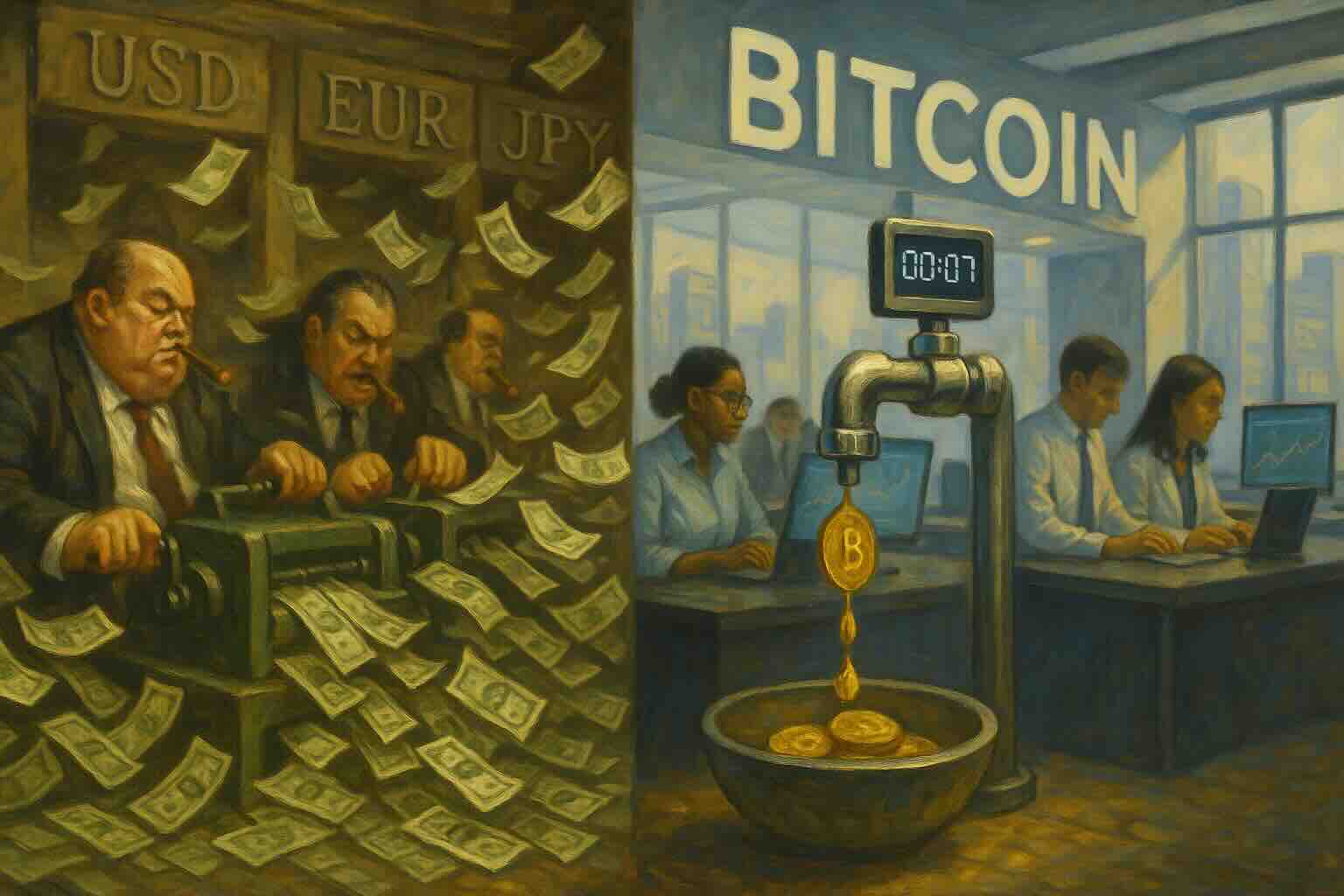
Bitcoin’s supply is capped at 21 million coins, forever. As designed, there will never be 22 million bitcoin, or even 21,000,001. This cap is built into the code. New bitcoin enters circulation through the mining process we described. Each new block creates a certain number of fresh bitcoin as the miner’s reward. But unlike gold mining (which can continue indefinitely) or fiat money printing (which can accelerate or decelerate at policymakers’ whim), Bitcoin’s issuance rate follows a fixed, diminishing schedule. The block reward started at 50 bitcoin per block in 2009, but it halves roughly every four years in an event aptly called the “halving.” It will keep halving every 210,000 blocks (\~4 years) until around the year 2140, when it reaches essentially zero new bitcoin. At that point, the 21 millionth (actually slightly less due to rounding) bitcoin will have been mined, and no more will ever be created. All of this is known in advance. It’s as if the Federal Reserve announced, in 2009, a precise schedule of exactly how many dollars would be printed every year for the next century, and then locked it in code so no one could change it.
This predictable, disinflationary supply is a radical departure from modern fiat monetary policy. In the traditional system, central banks like the Fed adjust the money supply based on economic conditions, often increasing it (which can lead to inflation and devaluation of existing money). Users of a currency have to trust that the central bank won’t debase their savings by printing too much—a trust that history shows is frequently betrayed. Bitcoin flips this script: no one can arbitrarily increase the supply of bitcoin. The rules of how Bitcoin’s money works are transparent and virtually unchangeable—encoded in the software that everyone is running. “The central bank must be trusted not to debase the currency, but the history of fiat currencies is full of breaches of that trust,” Satoshi wrote, explaining Bitcoin’s rationale for a fixed supply. By removing the ability of any authority to print money, Bitcoin aims to be inflation-resistant.
Bitcoin has become “digital gold”
Bitcoin is often called “digital gold” because of this scarcity. Like gold, it’s limited in quantity and costly to produce (mining requires work), in contrast to paper money which can be created with the press of a button. In fact, Satoshi explicitly drew inspiration from gold’s finite supply and the way gold mining becomes harder as easy deposits run out. Bitcoin’s code makes the mining puzzles automatically adjust in difficulty such that on average one block is found every 10 minutes, regardless of how many miners there are. So if more miners (or faster hardware) join and blocks come faster, the protocol raises the difficulty to slow it back to \~10 minutes. This ensures the issuance schedule stays on track—a steadily decreasing flow of new coins. In practical terms, Bitcoin started with relatively high “inflation” (50 bitcoin every 10 minutes was a lot when few were in circulation), but over time its inflation rate has dropped below 2% and will eventually approach 0%. The design creates digital scarcity: everyone knows there won’t be more than 21 million bitcoin, so each bitcoin (or each fraction of a bitcoin) is a unique piece of a fixed pie.
Of course, this approach has trade-offs. Bitcoin’s price can be volatile since supply is inelastic and fixed. Any change in demand leads to significant price swings. Also, one might ask: if new bitcoin stop being issued, what will incentivize miners to keep securing the network decades from now (around 2140\) when block rewards are near zero? The plan is that by then, Bitcoin usage will be high enough that transaction fees alone will incentivize miners. This is an open topic of discussion and one of the long-term economic questions for Bitcoin’s future. In the first decade‑plus of Bitcoin’s life however, the formula of digital scarcity and strong security has been effective. Bitcoin grew from an experiment worth essentially nothing into a globally recognized asset worth over 2 trillion dollars today, precisely because people came to trust its monetary policy and network resilience. As of 2025, millions of people hold bitcoin as a hedge against inflation or as “digital gold.”
Bitcoin as an Asset, bringing it all together
Bitcoin’s asset layer—its monetary policy and currency—directly addresses the inflation and trust in monetary authorities problems from Part 1. By coding in a fixed supply and transparent rules, Bitcoin removes the need to trust a central bank not to debase the currency. Anyone holding Bitcoin knows exactly what the supply is and will be, and thus can have confidence that their share of the total supply won’t be diluted unexpectedly. This predictability and scarcity is the polar opposite of our current fiat system, where money can be created in response to political or economic pressures.
Mapping the “Fiat Problem” to the “Bitcoin Solution”
In summary, the design of Bitcoin’s network, protocol, and asset each solves a piece of the puzzle:
| The Fiat Problem | Bitcoin’s Solution |
| ----- | ----- |
| Trust in centralized institutions to store and send value: We rely on banks/payment processors that can fail or restrict access. | Decentralization & Trustless Consensus: Bitcoin removes the need to trust any single institution. Its ledger is maintained by a network of nodes, and transactions are verified by code and math (Proof-of-Work) rather than a bank clerk. No bank can freeze your Bitcoin or deny a valid transaction—the network will include it as long as it follows the rules. |
| Single points of failure and control: A central bank or company can mismanage the system, get hacked, or be coerced by governments. | Peer-to-Peer Resilience: Bitcoin has no central point of attack or mismanagent. The network is global and redundant—even if parts are compromised, the ledger survives. This makes it censorship-resistant and robust against failures. As Satoshi noted, unlike Napster’s centralized model, a P2P network like Bitcoin “cannot be easily killed”. |
| Inflation and currency debasement by authorities: Central banks printing money leading to inflation (your savings losing value). | Fixed Supply & Transparent Issuance: Bitcoin’s supply is capped at 21 million and cannot be inflated by any authority. New coin issuance is on an algorithmic schedule (with halvings) known to all. This means no one can “debase” Bitcoin by creating more of it — a response to the historical breaches of trust by fiat issuers. |
| Opaque, changeable monetary policy: It’s hard for an average person to know how many dollars will exist next year, or when policies might change | Radical Transparency & Predictability: In Bitcoin, every rule is public. At any time, you can verify the total bitcoin in circulation (and that it’s following the expected curve). Monetary policy is basically on autopilot, defined in code. It would take near-unanimous agreement among users to change it, which is highly unlikely—unlike fiat where a few officials can decide to print trillions. |
| Intermediaries can censor or block transactions: Payment companies blocking donations to causes, banks freezing accounts. | Permissionless Transactions: Bitcoin allows anyone to send value to anyone else, anywhere, without needing approval. If you have bitcoin and an internet connection, you can pay someone directly—there’s no gatekeeper who can say “no.” Transactions are pseudonymous and cannot be unilaterally blocked. This gives individuals financial sovereignty on a global scale, fulfilling the internet’s promise of free exchange of value. |
Each of Bitcoin’s fundamental design elements were crafted as an antidote to a pain point of the traditional system. It’s a complete rethinking of money that marries concepts from computer science, cryptography, and economics. Bitcoin’s network ensures no single entity is in control (solving trust and single-point failure issues), its protocol ensures agreement and security without authorities (solving double-spend and transaction trust issues), and its asset component provides a form of money with predictable rules (solving inflation and policy trust issues). It’s this holistic design that makes Bitcoin so fascinating—and also challenging to grasp at first. But by breaking it into the layers of network, protocol, and asset, we see how each layer builds on the prior to achieve Satoshi’s vision of a trust-minimized digital currency.
Wrap Up
Now that we’ve unpacked how Bitcoin works and why it was built this way, we should talk about how this has played out in the real world. In Part 5, we will step back from the technical foundations and dive into Bitcoin’s living history. We’ll trace the major milestones and turning points of Bitcoin’s journey: from the early days of trading for pennies and using Bitcoin on dark-net markets, through the wild volatility and bubbles, to more recent developments such as corporations placing bitcoin in their treasuries and even nations adopting it as legal tender. We’ll also explore the fierce debates and forks that have occurred along the way (for example, the famous “block size wars” that led to community splits and alternative versions of Bitcoin). These stories illustrate how Bitcoin, the technology, is also deeply shaped by social, economic, and political forces. Bitcoin’s narrative has continually evolved—from cypherpunk electronic cash, to digital gold for investors, to a potential inflation hedge in an era of money printing, and beyond. We’ll examine how each era and narrative shift impacted the project’s trajectory.
Finally, we’ll consider the road ahead: the opportunities and challenges facing Bitcoin’s future. Scalability, energy usage, regulation, competition from other cryptocurrencies or central bank digital currencies. We will assess what threats could undermine Bitcoin and what innovations might reinforce it. After all, Bitcoin’s foundational design has proven resilient, but its story is still being written.