
This piece assumes basic familiarity with futures. CME’s introduction to futures contracts provides a short refresher.
Before the Opening Bell
On the morning of June 12, 2026, SpaceX had an IPO price of $135 a share and had yet to make its first public trade. To gauge an IPO’s likely opening price, traders typically follow updates from the listing exchange, such as Nasdaq or the New York Stock Exchange. The exchange uses buy and sell orders submitted before trading begins to estimate where buyers and sellers could agree on a price.
This time, however, Wall Street had another exchange to watch: Hyperliquid. Traders on the crypto exchange had spent weeks buying and selling contracts tied to SpaceX’s expected share price. Early that morning, MarketWatch quoted their roughly $176 price as a signal of where the stock might open.
Those contracts were perpetual futures, usually shortened to “perps,” Hyperliquid’s flagship product. Perps let people trade price movements around the clock and keep a trade open for as long as they can support it. To understand why perps are spreading from crypto into traditional finance, it helps to start with the limitation they remove from conventional futures: the expiration date.
The Problem With an End Date
Imagine Bob expects bitcoin to rise over the next year and wants to trade that view using futures. He wants to keep the trade open for a year, but the contract he finds expires in three months. To continue beyond that date, he would have to replace it with a later contract, a process called rolling.
Rolling lets Bob maintain his trade, although each replacement means another transaction and potential fees. He also has to manage the next expiration. Keeping the same yearlong view can therefore mean several contracts to manage and repeated trading costs.
In 2016, the crypto futures exchange BitMEX introduced its Bitcoin “perpetual swap,” a product commonly described today as a perpetual future. The contract had no scheduled expiration, and other exchanges adopted the approach. With a perp, Bob can choose when to close his trade, provided he keeps enough money in his account to support it.
Inside a Perp Trade
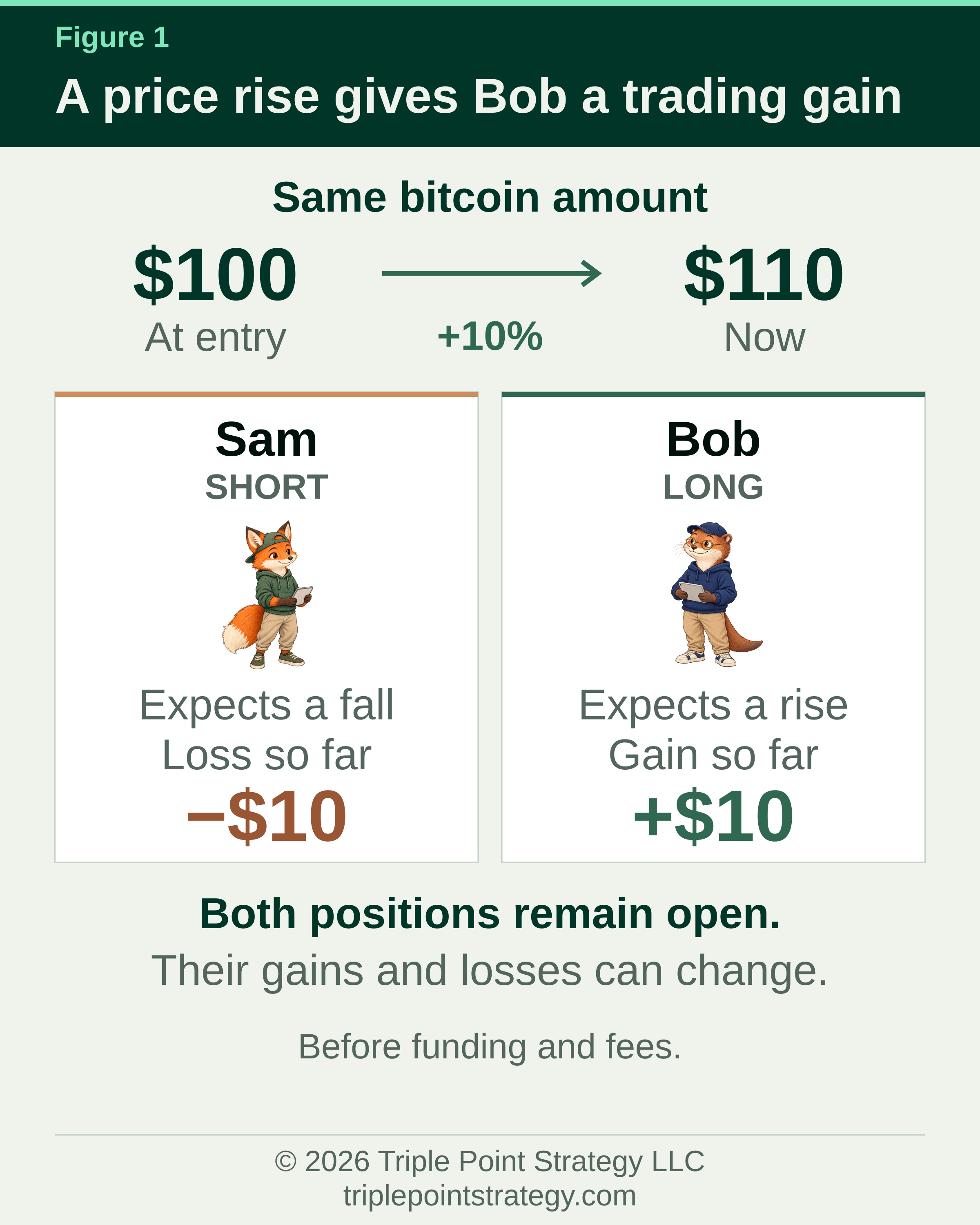
Let’s follow Bob as he opens a position. Sam expects bitcoin to fall, so he is willing to take the other side of Bob’s trade. Bob buys the contract, taking the long side, while Sam sells, taking the short side. As the contract’s price changes, the exchange records opposite gains and losses in their accounts. They are trading bitcoin’s price movements with no bitcoin changing hands.
Suppose they choose a trade linked to an amount of bitcoin worth $100 at the start. If the contract price rises so that the same amount is worth $110, Bob has a $10 trading gain matched by Sam’s $10 loss. Both positions are still open, so those gains and losses can keep changing before either trader decides to exit.
Each trader must put money into an account to cover possible losses. These deposits are collateral. The $100 sets the starting size of their trade; the collateral is the separate money each deposits to back it.
Why Perps Need “Funding”
Bob wants his perp to follow bitcoin’s price. However, the two prices come from separate markets. People buying and selling bitcoin itself establish its spot price, while traders buying and selling the perp establish the contract’s price. Strong demand to go long can push the perp above spot.
If Bob buys while the perp is unusually expensive, he can lose money as that gap closes even if bitcoin’s price stays flat. His trade would then depend partly on changes in the gap between the two markets. A contract designed to follow bitcoin needs a way to keep its price close to bitcoin over time.
This is where funding comes in. When a perp stays above spot, its rules generally require longs to make recurring payments to shorts. Bob therefore pays Sam while they keep their positions open, adding a cost to Bob’s long and income to Sam’s short.
Those payments give Bob a reason to reduce or close his long by selling. For Sam, the extra income makes holding the short more attractive and can draw other traders to sell the perp. Together, those incentives encourage selling that helps bring the contract price closer to spot. If the perp falls sufficiently below spot, payments can reverse direction, with shorts paying longs and encouraging buying instead.
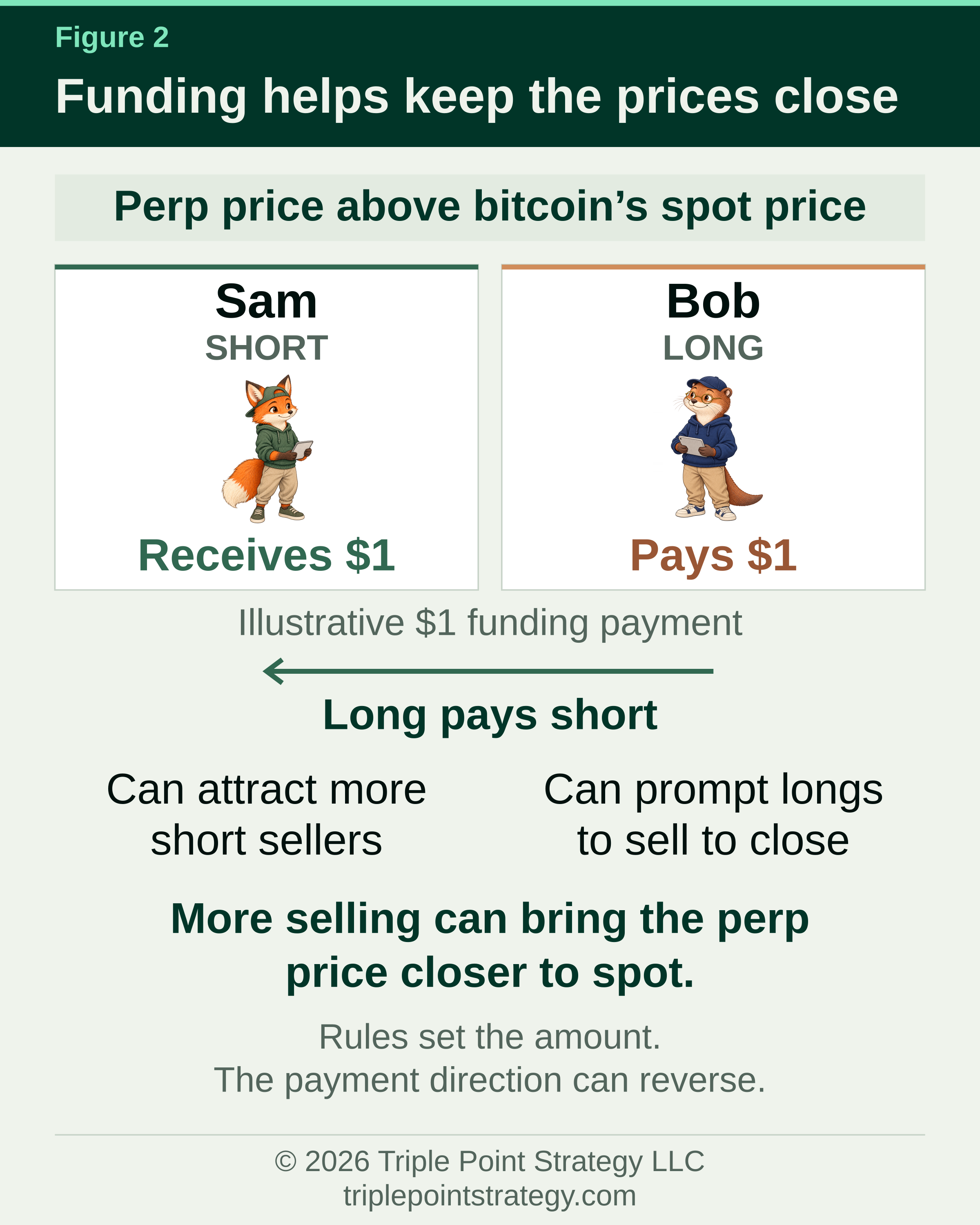
For Bob’s yearlong plan, funding becomes an ongoing cost to consider. The payment is recalculated as market conditions change, so it can rise, fall or reverse direction during his trade. If he keeps paying for long enough, the total could consume his trading gain or exceed it. He needs to follow both the contract’s price and the payments required to hold it.
The Appeal of Leverage
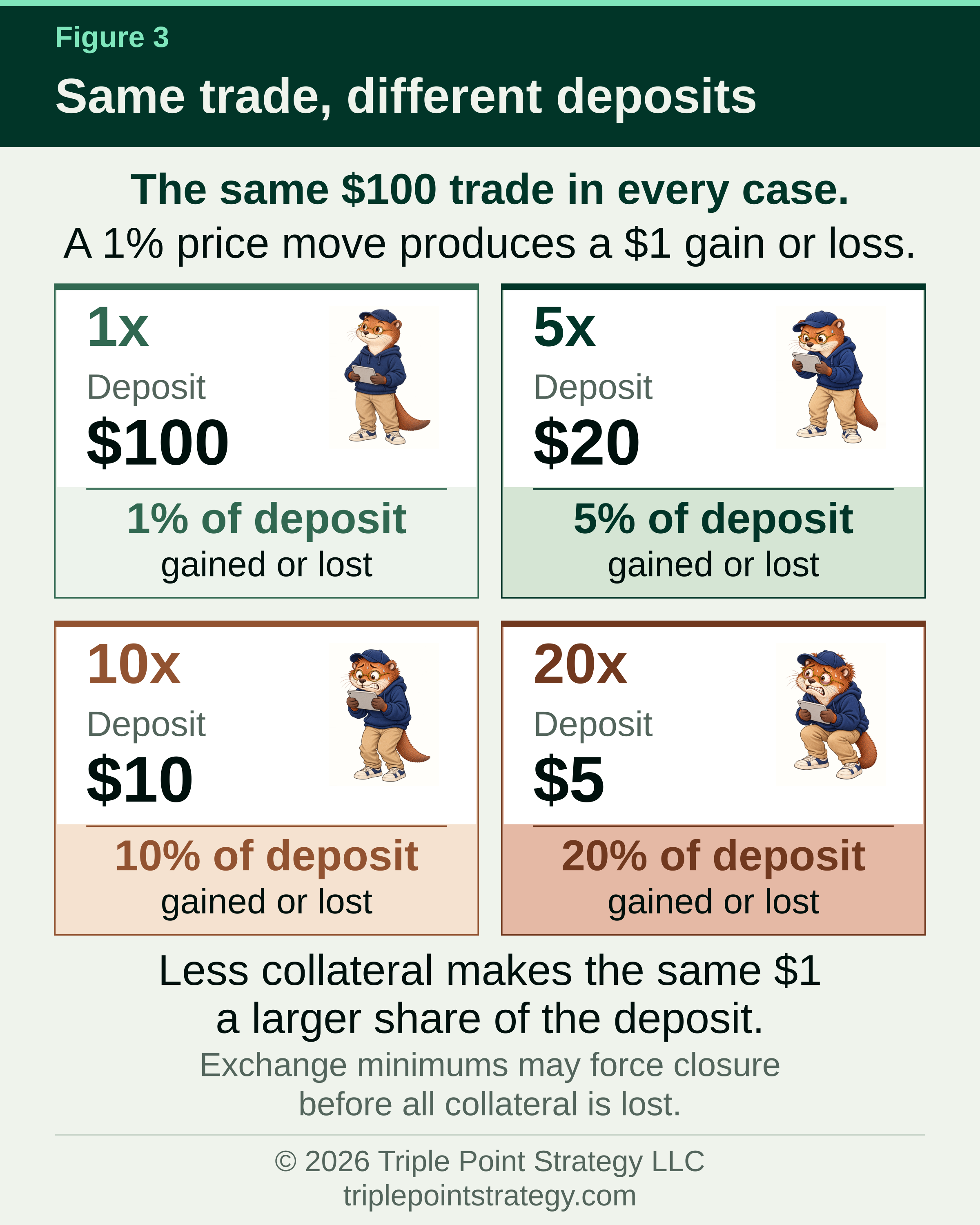
Funding payments and trading losses draw on Bob’s collateral, and he has a choice about how much money to deposit. Leverage lets a trader hold a position larger than the deposit supporting it. At the start of our $100 trade, Bob could deposit $20 if the exchange permits. His position would be five times his deposit, which traders call 5x leverage.
That lets Bob take the trade he wants while keeping more money available elsewhere. It also makes each dollar gained or lost a larger share of his deposit. His $10 trading gain would equal half the $20 he put in, before costs; the same $10 loss would consume half of it. For a given deposit, higher leverage also allows a larger trade.
The ability to turn a modest price move into a large gain on deposited money helps explain why leverage features so prominently in perps trading. Platforms make the multiple easy to adjust, and some offer up to 100x on selected markets. However, at those levels, even a small unfavorable price move can consume a large share of the money backing the trade.
The account must always meet the exchange’s minimum requirement. If trading losses or funding payments push Bob below that requirement, the system can force some or all of his trade to close. This is liquidation. Bob could correctly anticipate bitcoin finishing the year higher and still have his position liquidated during an earlier decline.
For our running example, Bob keeps enough money in his account to cover losses and funding. At the end of the year, he decides to exit by selling the same contract quantity he originally bought. He now needs a buyer willing to take it at a price he can accept.
The Rise of Hyperliquid
Finding that buyer is easier in a liquid market, where traders can enter and exit useful amounts without moving the price sharply. Suppose Bob sells at the $110 level shown in Figure 1. His position returns to zero, closing the long with a $10 trading gain. Funding paid along the way and the exchange’s trading fees reduce what he keeps.
The exchange therefore shapes how useful the contract is. Traders want orders to go through quickly and enough buyers and sellers to trade at competitive prices. Centralized venues such as BitMEX had established demand for perps years before Hyperliquid arrived and decentralized venues such as dYdX had already offered them too. However, Hyperliquid’s founders saw room to improve the experience of trading onchain.
The team approached the problem as traders. Co-founder Jeff Yan has described FTX’s collapse as the event that made the importance of control over customer funds immediate. Hyperliquid set out to combine responsive trading with an exchange whose activity could be inspected on a blockchain. It launched in 2023 with a network built around the exchange: orders, trades, and the collateral backing positions are all recorded onchain.
That design gives traders familiar order-book trading where buy and sell orders meet at agreed prices along with a public record of how the market operates. Speed and usability also help attract participants; their orders make the market more liquid, which can attract others. This reinforcing relationship helps explain how a venue can gain momentum once it becomes a useful place to trade.
As of October 29, 2026, Hyperliquid had processed about $207 billion of perp trading over the preceding 30 days. It also accounted for about 57% of the dollar value of open perp positions across tracked onchain exchanges. That gives it a substantial lead within onchain perps. A portion of Hyperliquid’s fees funds purchases and burns of HYPE, its token, connecting some of that business activity to demand for the asset.
Markets Beyond Crypto
An exchange with an existing trading community also gives new markets somewhere to find customers. Hyperliquid lets independent teams create contracts using its trading system. Those teams choose what their contracts follow and take responsibility for their pricing rules. They can bring stocks, commodities, and indices to infrastructure that traders already use.
The SpaceX quote in the opening came from one of these markets. Before the Nasdaq debut, there was no live public share price for the perp to follow. Buyers and sellers were trading their expectations of what the shares could be worth. Their orders turned those views into an observable price, a process known as price discovery. Holding the contract gave them price exposure without ownership of SpaceX shares.
SpaceX’s shares eventually opened at $150, above the $135 offer price and below the roughly $176 perp quote reported earlier that morning. Orders for actual shares determined the opening; the perp had supplied an earlier market for expectations. Public trading then provided a stock price the contract could follow. Stock-linked perps can also keep trading overnight and across weekends, giving traders a way to respond to news while the stock exchange is closed.
Our Perspective
We see growing evidence that perps have found product market fit: traders use them often enough to support substantial exchange businesses and their uses now extend beyond crypto prices. Crypto has produced other waves of adoption, from token fundraising through initial coin offerings to digital collectibles and prediction markets. Those histories give investors a reason to critically examine which uses sustain demand after the initial excitement fades.
They also show how leadership can change as a market develops. Compound was an early leader in onchain lending before Aave became the largest protocol in that category. Polymarket gained prominence around the 2024 U.S. election, while Kalshi subsequently grew into a major competing venue. Perps already have a long history in crypto, but their expansion into traditional assets brings another phase of competition.
That competition is arriving through established institutions. Coinbase launched stock perps for eligible customers outside the U.S. in March 2026 and Robinhood’s 2026 product rollout includes crypto perps. Both bring existing customer relationships and distribution. For traders who already use them, access through a familiar provider can reduce the effort required to try a new product.
U.S. regulators are also creating paths for these products to reach customers. In May, the CFTC approved Kalshi’s bitcoin perp and issued guidance supporting Coinbase’s plan to offer certain overseas-listed crypto perps. The agency encouraged firms proposing additional types of perpetual contracts to engage with its staff. We view that willingness to work through specific products and operating rules as encouraging. Regulatory access will help shape which venues can serve the next group of users.
Hyperliquid enters this competition with an established trading community, substantial onchain liquidity, and infrastructure that outside teams can use to add markets. We see those as meaningful advantages. Its expansion beyond crypto gives the protocol more room to grow and brings it into competition with firms that already serve millions of customers. Sustained trading and fee income will show how much demand onchain venues retain as those alternatives become available. Hyperliquid has earned a strong position in this developing market. However, in our view, we are still too early to confidently declare market dominance and continued category leadership.