
Key Takeaways
- Major Policy Shifts: In May 2025, the U.S. Department of Labor rescinded its 2022 guidance that discouraged retirement plan sponsors from offering crypto to their plan participants. Additionally, President Trump has announced support for giving retirement plans access to alternative investments like digital assets.
- Crypto’s Investment Appeal: Digital assets like Bitcoin and Ether offer diversification, inflation hedging, and high-growth potential. These benefits are further amplified when the assets are held within tax-free retirement accounts.
- Trillions in Potential Inflows: U.S. employer-sponsored retirement plans hold over $12 trillion in assets. Even a small allocation to crypto could result in hundreds of billions, if not trillions, of dollars in new capital inflows.
- Key Challenges Remain: In order to roll out a crypto offering to retirement plan participants, plan sponsors would need to address a variety of hurdles including sufficient investor education.
Intro
In 2022, the U.S. Department of Labor (DOL) issued guidance discouraging retirement plan sponsors, like Vanguard, from offering digital assets to their customers. Volatility, valuation challenges, custody risks, and the potential for fraud were all cited as concerns. This cautious stance created a significant regulatory headwind, limiting crypto exposure via retirement plans to self-directed IRA accounts.
This year however, there have been two major developments which could pull employer-sponsored retirement plans off the sidelines and into the crypto markets:
- In May 2025, the DOL rescinded their 2022 guidance
- Last week, President Trump stated he'd sign an executive order for regulatory agencies to investigate how to make alternative investments, such as digital assets, broadly available to retirement plans
In this research brief, we look into what it might mean for crypto markets if digital assets were made available to employer-sponsored direct contribution retirement plans.
Why Crypto Belongs in Retirement Portfolios
Before jumping into the market implications, it is worth considering two key questions:
- Which digital assets would most likely be offered?
- Why would people allocate retirement contributions to digital assets?
In our opinion, Bitcoin would be available first to plan participants, followed by Ethereum’s native token Ether (ETH). These are the two largest cryptocurrencies, and this sequence aligns with how corporations and governments have been adding digital assets to their balance sheets.
Why should someone consider allocating retirement contributions to crypto? We see several reasons:
Diversification Benefits: Crypto has a low correlation with traditional assets like stocks and bonds. Compared to traditional assets, crypto is particularly sensitive to changes in global liquidity. Bitwise’s Crypto Market Review (Q1 2025) report shows how including both Bitcoin and Ether in a traditional 60/40 portfolio can significantly boost returns.
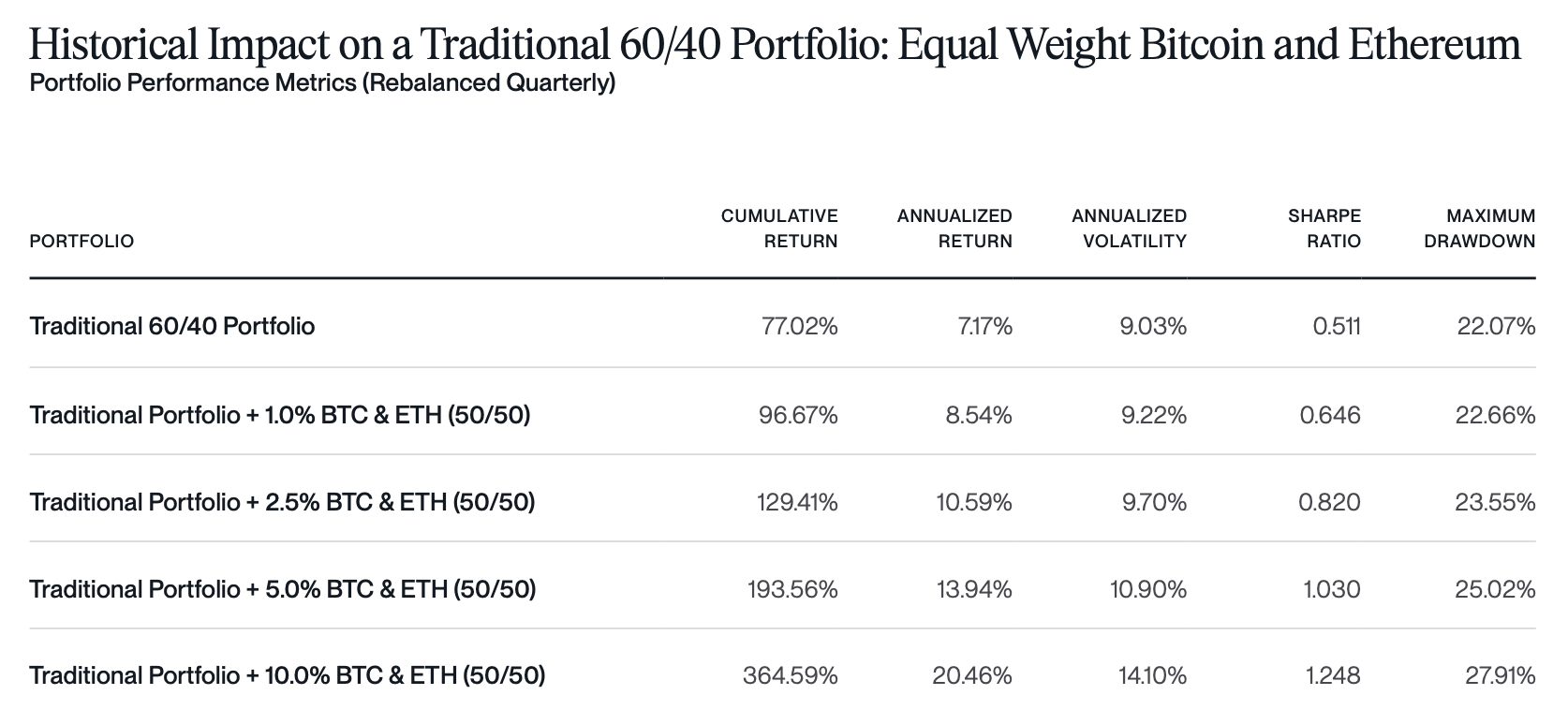
Inflation & Monetary Policy Hedge (The "Digital Gold" Narrative): Ballooning government debt and the pace of money printing are generally considered significant systemic risks. Digital assets like Bitcoin, with its fixed supply of 21 million units, are increasingly being viewed as a potential long-term hedge against poor monetary policy.
Tax Free Growth With Asymmetric Upside: At $3.9 trillion, crypto is still a small asset class relative to global stocks ($124 trillion) and bonds ($140.7 trillion). We are seeing major advances in crypto adoption through U.S. legislation like the GENIUS Act, as well as the addition of crypto to corporate and government balance sheets. Even if crypto becomes just one tenth the size of stocks or bonds, retirement plan participants could be looking at 3-4X return that would be completely tax free.
Retirement Plans Offer Trillion Dollar Inflows
The most significant implication of including crypto in employer-sponsored retirement plans would be the sheer scale of capital inflows. This includes both the enormous pool of existing retirement savings as well as new contributions. Consider these figures:
- U.S. employer-sponsored direct contribution retirement plans, for example 401(k)s and 403(b)s, hold an estimated $12.2 trillion in assets as of Q1 2025. The U.S. Government Accountability Office estimates that crypto currently represents less than 1% of those holdings.
- Even a modest reallocation from these retirement accounts, into crypto, could translate into significant inflows:
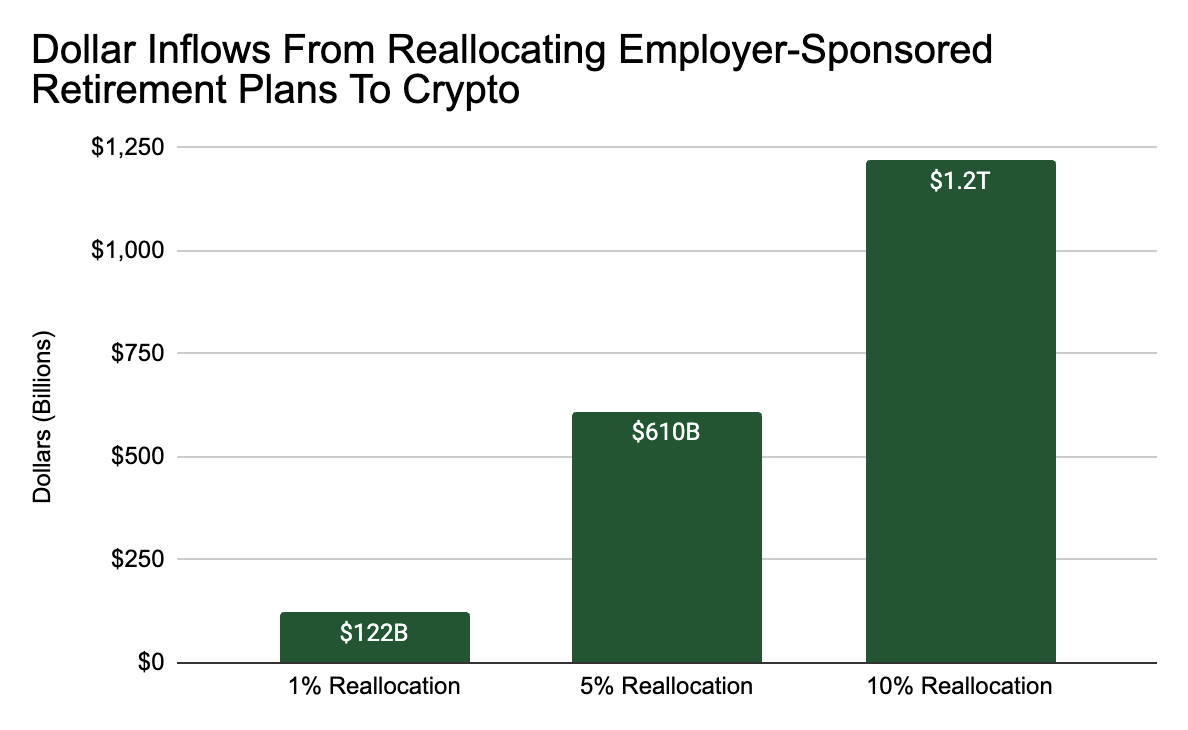
These numbers show the transformative potential, but they don’t paint the whole picture. We haven’t considered the dollar inflows from ongoing contributions. An estimated $500 billion is contributed by employees and employers into 401(k)s each year alone. Using the same 1-10% allocation range, that could mean $5-50 billion in annual inflows into crypto. When you add in crypto supply considerations, things get increasingly bullish.
We can expect that the crypto purchased through these inflows will be held for the long-term since people don’t frequently adjust their retirement contribution allocations. Bitcoin has a hard cap of 21 million units and ETH’s issuance is capped at 1.51% annually. As contributions continue, the demand would likely outpace supply. The effect could be a massive spike in Bitcoin and ETH valuations.
Plan Sponsors Must Overcome Several Headwinds Before Crypto Is Rolled Out To Retirement Plans
While the upside for retirement plan participants is considerable, there are still several risks and headwinds which need to be addressed before we start seeing crypto rolled out to employer-sponsored retirement plans:
Volatility Remains: Cryptocurrencies are, by nature, highly volatile. Price swings can be dramatic and swift. This requires a long-term investment horizon and a clear understanding that short-term fluctuations are part of the asset class.
Lack of Extensive Long-Term Data: Compared to centuries of data for stocks and bonds, the history of crypto as an asset class is relatively short. This means less historical data is available for modeling and forecasting long-term performance.
Evolving Regulatory Landscape: Despite the positive signals from Washington, the broader regulatory environment for cryptocurrencies is still being developed. Future regulations could impact market dynamics, valuations, and usability.
Custody and Security: The security of digital assets is critical. Plan sponsors must ensure that any crypto offering utilizes robust, institutional-grade custody solutions to protect against theft, hacking, and other security risks.
Fiduciary Duty is Unchanged: Plan sponsors remain bound by their fiduciary duty to act prudently and solely in the best interests of their participants. This requires rigorous due diligence on any crypto-related investment, understanding the underlying technology, assessing fees, and ensuring appropriate risk disclosure.
Participant Understanding is Key: It is important that plan participants are provided with clear, comprehensive education on the risks and rewards of investing in digital assets. This knowledge will be critical to enabling plan participants to make informed decisions that align with their individual risk tolerance and retirement goals.
Wrap Up
The DOL's recent moves, and President Trump’s positive announcement, are the first of many stepping stones that would allow Americans to unlock significant growth within their employer-sponsored retirement plans. This potential is underscored by the immense scale of the retirement plan market. Even small allocations could translate into hundreds of billions, or even a trillion dollars, in new crypto inflows over time.
Crypto exposure through employer-sponsored retirement plans would be transformational for the digital asset industry. Yes, there are still headwinds which need to be addressed before it can become a reality. We strongly believe however that plan sponsors will eventually overcome these challenges, and that investors who decide to get in front of this next wave of demand will be rewarded.
About Triple Point Strategy
Triple Point Strategy is a research firm and crypto investment manager. We operate the Marietta DeFi Fund, a crypto investment fund that is focused on capital appreciation and DeFi-native income strategies. It is currently available to U.S. accredited investors. Subscribe below to receive our latest insights directly in your inbox.
For U.S. accredited investors only. Offered under Rule 506(c) of Regulation D. This content is for informational purposes only and does not constitute financial, investment, or tax advice. This is not an offer to sell or a solicitation to buy any security. Any investment may only be made through the Fund's confidential offering documents. Investing involves risk, including possible loss of capital. Digital assets are volatile and subject to changing regulations.