
Key Takeaways
- Bitcoin’s security relies on a compensation mechanism that is designed to shrink over time, creating long-term risks for the network’s health and ability to incentivize miners.
- Transaction fees are unlikely to scale quickly enough to fill the gap, and relying solely on price appreciation has hard limits.
- If miner incentives fall too low, the network becomes vulnerable to 51% attacks — a threat that makes the network fragile and grows more plausible over time without a major intervention.
- Investors should recognize that crypto protocols involve complex trade-offs, and long-term capital should be guided by a deep understanding of these dynamics.
Intro
There is no denying Bitcoin’s meteoric rise. In 2025, Bitcoin broke $110,000, capital is pouring into newly approved spot ETFs, and the cryptocurrency is being added to the balance sheets of governments and corporations alike. Despite all the positive signals, Bitcoin’s security budget presents a looming existential risk that every current and prospective Bitcoin investor should understand.
What Is Bitcoin’s Security Budget?
To appreciate why Bitcoin’s security budget is such a risk, it helps to first understand how the network is secured. Bitcoin uses a consensus mechanism called Proof of Work to verify transactions on the network. Proof of Work at a high level involves:
- Users creating Bitcoin transactions
- Miners grouping those transactions into blocks
- Miners verifying the block via a Bitcoin-specific hashing algorithm
- The Bitcoin network compensating the first miner to verify the block via a “block reward”
Bitcoin mining is highly competitive and resource intensive. It requires a significant investment in specialized servers and high electricity costs to run the hardware. The block reward is how miners are compensated for the work they do to secure the network. The security budget is simply the block reward expressed in fiat currency (i.e. USD).
One of the critical things to understand about the block reward is that it consists of two parts: transaction fees and the block subsidy.
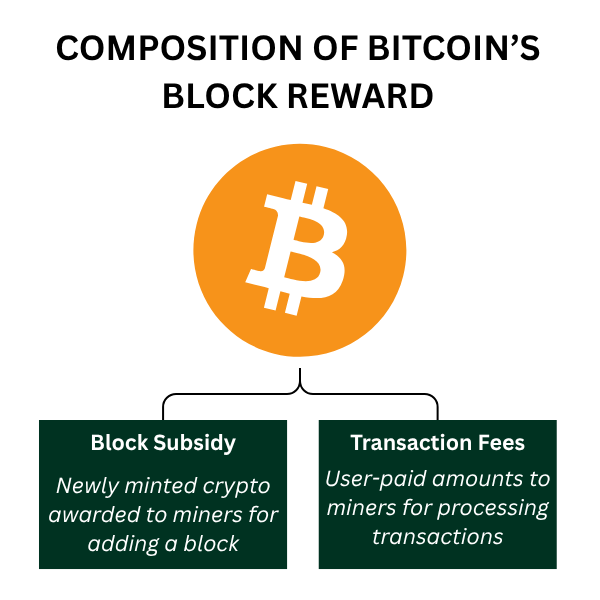
Transaction fees are exactly as they sound. Users pay a small fee when executing a transaction and those fees typically account for less than 5% of the block reward. The block subsidy is new bitcoin that is minted after each block is verified. The chart below shows the security budget’s composition for all blocks verified each month:
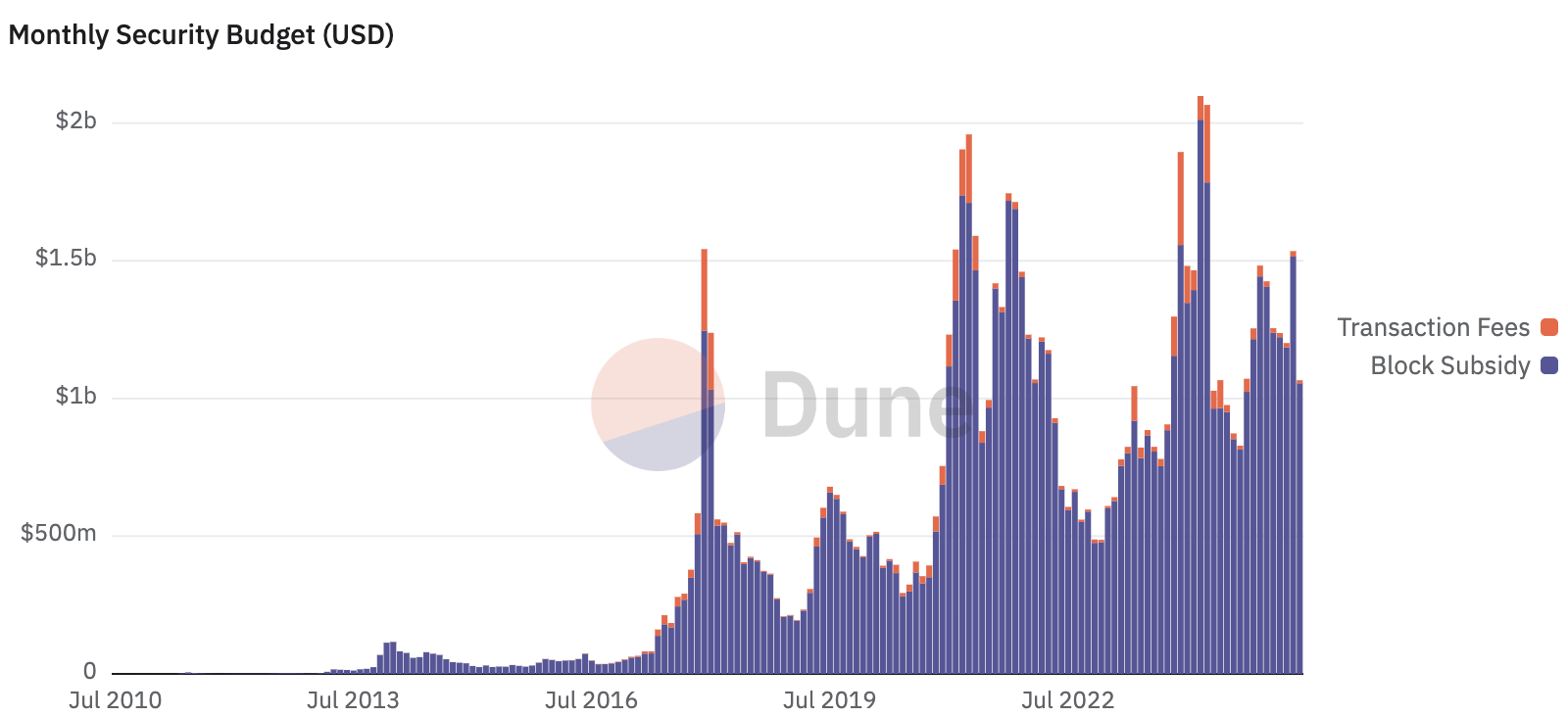
The key takeaway here is that, in a typical month, the block subsidy represents practically all of Bitcoin’s security budget. With that in mind, we can now discuss how Bitcoin’s current design directly conflicts with its security budget.
How Bitcoin’s Design Undermines The Security Budget
Bitcoin’s fixed supply of 21 million is a key feature of the protocol. Today, approximately 94% of the total bitcoin supply is available for use. The remaining 6% will be released via the block subsidy system through the year 2140.
When Bitcoin first launched in 2009, the block subsidy was 50 bitcoin. Approximately every 4 years, the subsidy is cut in half. The chart below shows the halving schedule for the block subsidy. You can see that, after 2032, the subsidy drops below one bitcoin.
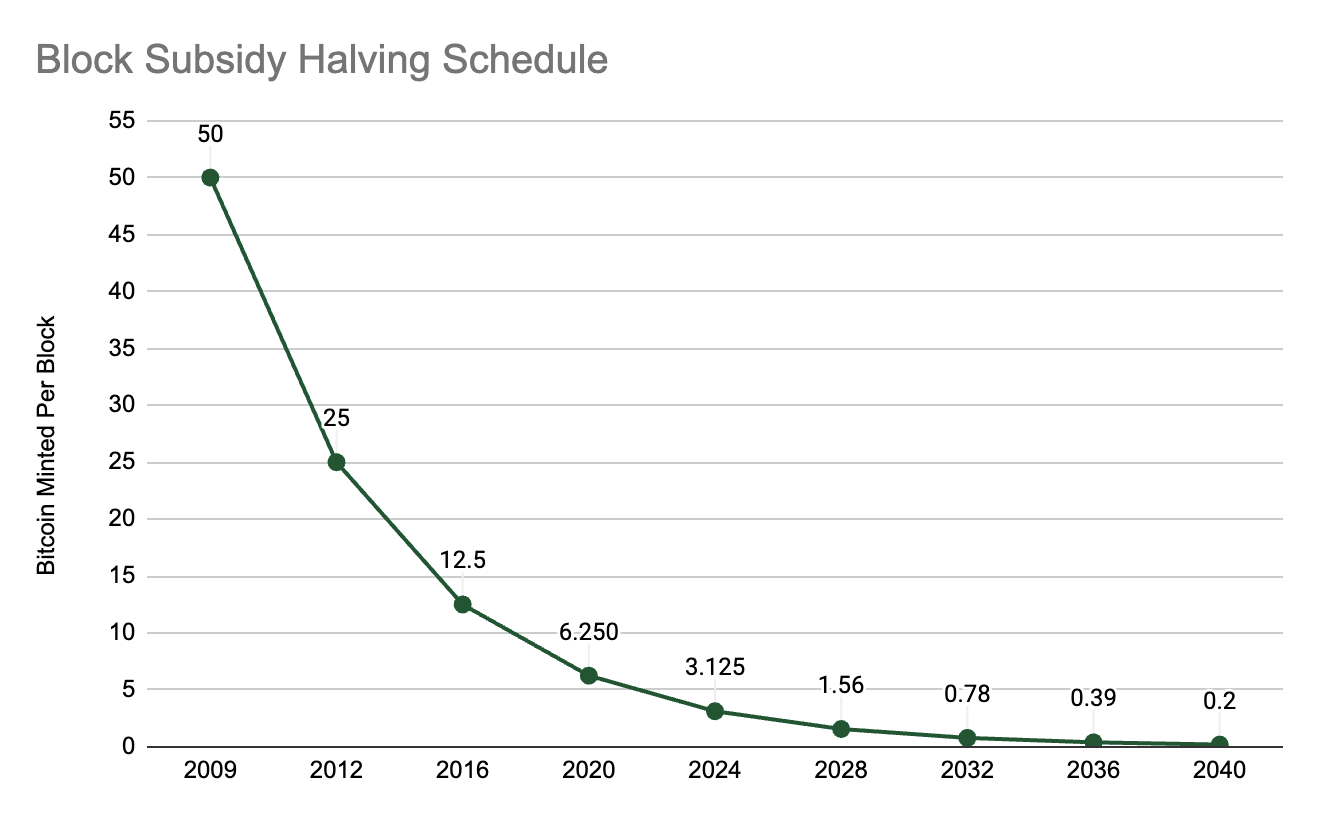
This drop is the core problem with Bitcoin’s security budget. Mining bitcoin can be expensive, depending on the geography, yet the primary mechanism to compensate miners is rapidly shrinking. To ensure miners are profitable and continue to secure the network, either the price of Bitcoin must rise or the total transaction fees per block will need to increase.
Transaction Fees Are Unlikely To Fix The Issue
While a surge in transaction fees could technically solve the security budget issue, we believe that outcome is unlikely to happen organically. The Bitcoin network would need to see a significant increase in both transaction volume and fees per transaction to make up for the diminishing block subsidy. Higher fees discourage lower transaction values, which negatively affects transaction volume.
Additionally, Bitcoin appears to be following the “digital gold” rather than the “digital money” narrative. As a result, we expect people will use bitcoin as a long-term store of value rather than a means for frequent and daily transactions. Right now, there just isn’t line of sight to a clear catalyst for increased transaction volume other than people and entities periodically accumulating bitcoin. As such, the transaction fee solution appears highly unlikely.
Price Appreciation Will Help But Has Limitations
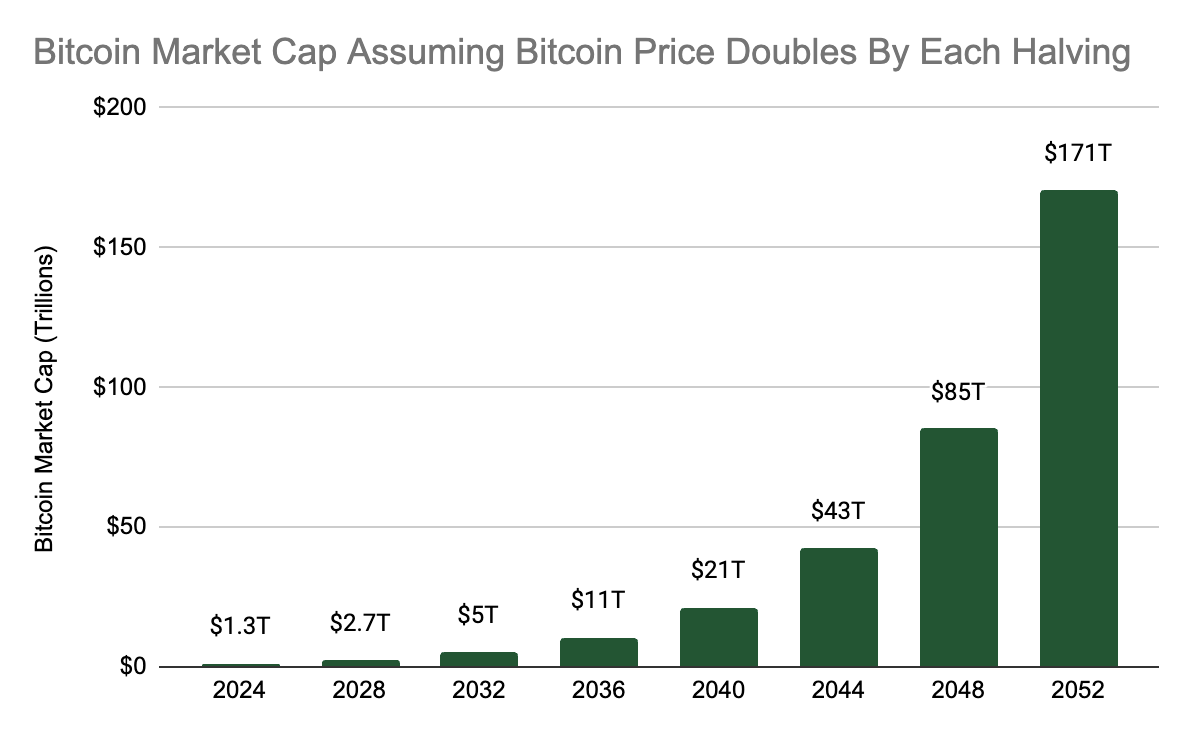
Bitcoin’s price appreciation has helped maintain network security through four halving events. With a market capitalization of around $2 trillion, the asset would need to double in value every four years to sustain its current security budget. The problem is that global wealth stands at around $500 trillion. While there is plenty of room for Bitcoin’s value to grow, there are limitations as to how much capital will be allocated to the asset. Here is a chart showing the total market capitalization of Bitcoin assuming the price doubles every four years to keep up with each halving event.
And here is a chart showing Bitcoin’s current market capitalization relative to other global reserve asset benchmarks:
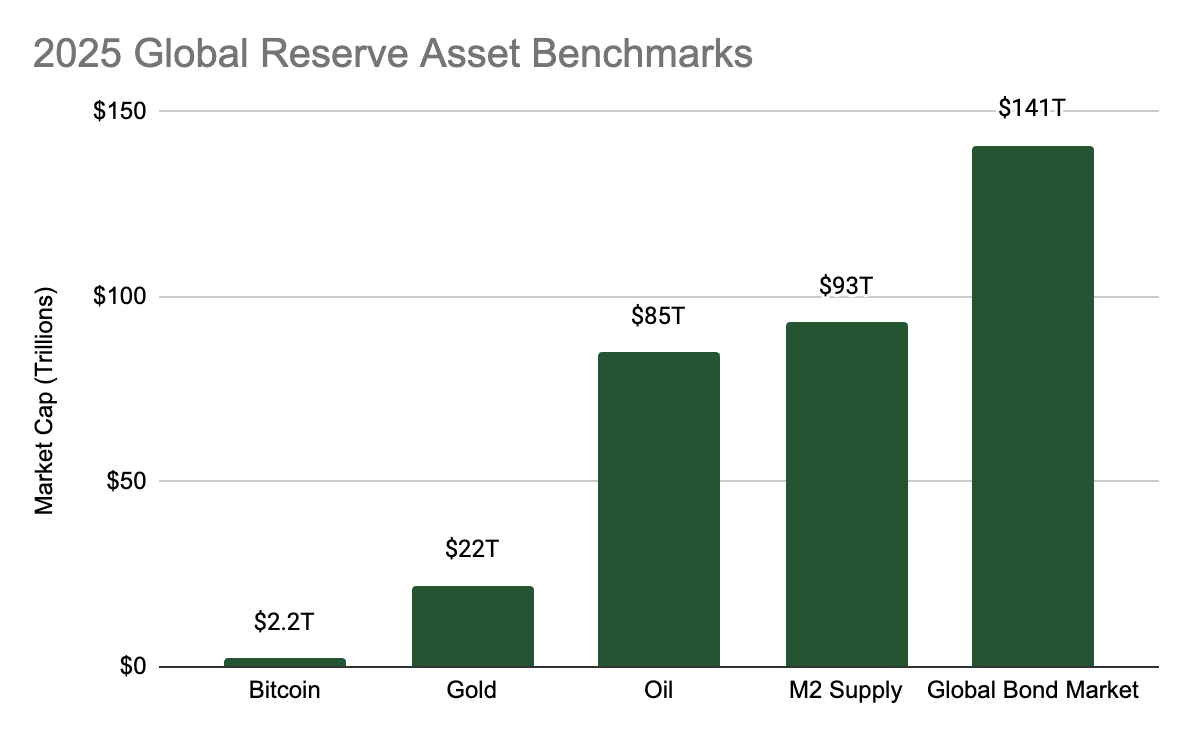
The key takeaway here is that Bitcoin will need to reach the market capitalization of gold by the year 2040 and match the total value of oil (a further 300% increase) just 8 years later. To achieve this valuation, Bitcoin would need to be a substantial magnet for global wealth with 10s of trillions of dollars flowing into the asset. Those trillions of dollars would also need to flow out of another asset class. Investors should carefully consider where Bitcoin’s required rate of appreciation starts to look unreasonable.
An Underfunded Security Budget Leads To A Fragile Network
If the security budget can’t keep up with miners’ operational costs, it’s rational for them to stop securing the network. Doing so would reduce the hash rate (the total computing power securing the network) and open the Bitcoin network up to a “51% attack”.
A 51% attack is where a single or coordinated group of bad actors control more than 51% of the hash rate. If a 51% attack were to occur, these bad actors could, in theory, double spend their bitcoin, deny new transactions from being validated, or even rewrite Bitcoin’s transaction history. A 51% attack would shake investor’s confidence in Bitcoin, and its value would likely plummet. Given it would cost several billion dollars to conduct a 51% attack, we believe nation states looking to disrupt rival countries would be the most likely to conduct such an attack.
Addressing Bitcoin’s Broken Security Budget
Despite the concerns noted above, there are options and scenarios that would mitigate Bitcoin’s security budget risk. We believe there are two broad buckets of solutions:
Technical Solutions
The Bitcoin Core development team could advocate for a variety of technical changes to address the security budget issue. This includes:
- Increasing the total supply of bitcoin above 21 million units or implementing a tail emission (i.e. a tiny block subsidy included in the block reward in perpetuity)
- Increasing the number of transactions included within each block to boost transaction fees per block
- Changing the consensus mechanism from Proof of Work to Proof of Stake, as Ethereum did, to shift the means to conduct a 51% attack from computing power to bitcoin holdings
Despite there being multiple technical solutions, historically, the Bitcoin Core community has rejected technical changes which deviate from Bitcoin's original vision. Hence, getting these changes implemented would be unlikely without extreme external pressures.
Corporations And Governments Take An Active Role In Mining
If corporations and governments continue to add bitcoin to their balance sheets as we expect, they will be incentivized to keep the network secure. If the security budget cannot consistently cover miner’s operational costs, we could see corporations and governments become more active in the mining ecosystem. These entities may eventually build out their own mining operations or subcontract it out to established and reputable Bitcoin mining companies.
While this approach helps with the security budget issue, unfortunately, the solution is not bulletproof and leaves the network fragile. If the hash rate is low enough, one or more governments still have the ability to buy their way into controlling 51% of the hash rate. With that being said, the risk can likely be mitigated via onchain data and global economic alliances. While it isn’t a perfect outcome, it is the one we feel is the most likely to occur.
Wrapping Up
Bitcoin’s security budget is not an immediate crisis, but it is a slow-moving and structural challenge that grows more pressing with time. No one can say with certainty when it will begin to materially impact the network. It could be decades away, or it could become an issue as soon as the next halving in 2028. What we do know is that without a change, the math doesn’t look good. The subsidy shrinks, miner incentives drop, and eventually the network may be forced to reckon with trade-offs that have been easy to ignore during periods of growth.
This is not a risk that shows up in Bitcoin’s price chart, market cap, or ETF flows. It’s buried in the protocol’s economic architecture — a design feature that made sense in 2009 but looks increasingly fragile in a world where trillions of dollars may soon rely on the security of this system.
For both current and prospective investors, the takeaway is simple: keep watching. Bitcoin is not static. It is an evolving system built on complex trade-offs, and long-term capital should be allocated with those dynamics in mind.
About Triple Point Strategy
Triple Point Strategy is a research firm and crypto investment manager. We operate the Marietta DeFi Fund, a crypto investment fund that is focused on capital appreciation and DeFi-native income strategies. It is currently available to U.S. accredited investors. Subscribe below to receive our latest insights directly in your inbox.
For U.S. accredited investors only. Offered under Rule 506(c) of Regulation D. This content is for informational purposes only and does not constitute financial, investment, or tax advice. This is not an offer to sell or a solicitation to buy any security. Any investment may only be made through the Fund's confidential offering documents. Investing involves risk, including possible loss of capital. Digital assets are volatile and subject to changing regulations.