
Key Takeaways
- Staking turns crypto into an income-generating asset. Token holders can earn rewards for performing valuable network services like transaction validation or providing insurance.
- Unlike dividends, staking rewards are opted into, paid in native tokens (like ETH), and tied to network activity rather than company profits.
- Staking rewards come with real risks. Volatility and the loss of collateral, via slashing, can offset potential yields.
- Access to staking varies by investment vehicle, making managed DeFi funds like the Marietta DeFi Fund an efficient entry point for diversified staking exposure.
Intro
“You can earn dividends with crypto?” is a clarifying question we hear all the time when talking to investors who are new to digital assets. While crypto protocols don’t offer dividends exactly as equities do, some cryptocurrencies have a mechanism called “staking” that allows holders to earn income on their assets. In this research brief we discuss what staking is, why staking income is different from traditional dividends, and how investors can take advantage of it in their portfolio.
What Is Staking?
At its core, staking is the process of a token holder performing a service for a crypto network. A classic example of a crypto network that leverages staking is Ethereum. The Ethereum protocol needs transactions between parties to be validated, just like other crypto networks such as Bitcoin. For correctly validating transactions, the Ethereum network is willing to pay a reward. That reward is paid in ETH, the Ethereum network’s native currency, and for all intents and purposes can be thought of like a dividend distribution for performing the service.
If a token holder wants to verify transactions for the Ethereum network, they will need to put some ETH at stake. This effectively means putting ETH up as collateral, and it is the economic incentive for the token holder to verify transactions as the Ethereum network expects.
So long as transactions are validated correctly, the Ethereum protocol will pay the reward and the collateral will remain untouched. If a token holder performing the service decides to act maliciously, for example trying to pass invalid transactions off as authentic, then part of the collateral they put at stake is automatically taken by the network. This process of taking collateral from a staker is called slashing.
Verifying transactions is just one example of staking. Aave, a decentralized crypto lending platform, decided to create an insurance fund in the event there are a significant number of bad loans and borrowers cannot repay lenders. While Aave has mechanisms in place to prevent these repayment shortfalls from happening during normal market conditions, black swan events could trigger the need to dip into the insurance fund.
Aave offers the ability for token holders to stake their AAVE in the insurance fund. For every day the insurance fund doesn’t need to be drawn upon, stakers earn a reward. If the insurance fund did need to be drawn from, the staked AAVE could be sold (i.e. slashed) to repay lenders. When deciding to stake, it is critical to understand how much the network is willing to pay for the service being performed (i.e. the yield) and whether that reward justifies the slashing risk.
How Is Staking Different Than Dividends?
Now that you understand the core idea behind staking, it is much easier to see why it is different from traditional dividends. Here is a table summarizing a few key differences:
| Attributes | Crypto Staking Income | Traditional Equities |
|---|---|---|
| Source of Yield | Rewards for providing the protocol a service, driven by network activity and fees | Excess cash from profits as voted by the Board of Directors |
| Income Mechanism | Active decision to stake | Passive feature of ownership |
| Income Frequency | Typically Daily | Quarterly |
| Form of Distribution | Native Token (e.g. ETH) | Cash (e.g. USD) |
| U.S. Tax Treatment | Ordinary Income | Qualified or Non-Qualified Dividend Income |
| Primary Risks | Asset volatility, slashing and smart contract risk | Asset volatility and company solvency |
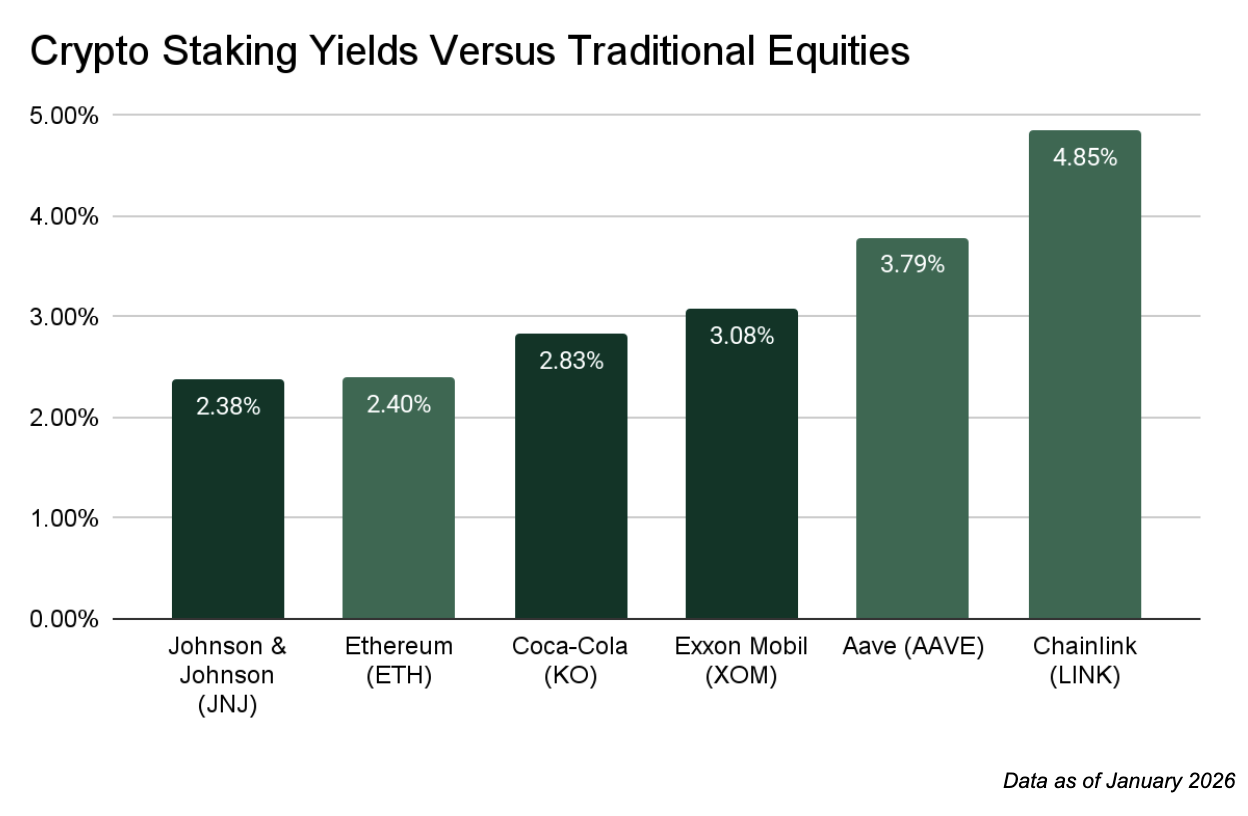
For traditional income investors, the dividend yield is a key metric when building a portfolio. The same concept applies for cryptocurrencies. Below is a chart showing the staking yield of a select group of cryptocurrencies, versus the dividend yields of some established equities. The equities are colored in dark green.
Ways To Stake Your Crypto
Unfortunately, staking is not yet available across investment platforms and vehicles. For example:
- Coinbase and Robinhood offer staking for spot Ethereum, while Fidelity does not.
- Ethereum ETFs don’t currently offer staking income, although BlackRock has filed for a new ETF which would offer that feature. It is important to note, however, that liquidity requirements for redemptions mean the ETF may not be able to stake 100% of the assets under management. This hurts the overall yield.
- Staking AAVE or LINK is not currently available through any U.S. investment platform or ETF. To gain exposure to AAVE or LINK staking, an investor must interact directly with that protocol on the blockchain or use a private crypto investment fund like the Marietta DeFi Fund.
Wrap Up
Crypto investment strategies have expanded significantly beyond the “buy and hold” mantra that Bitcoin first established. Today, investors can earn income by providing a real service to a variety of crypto protocols. Unfortunately, these income strategies are not always accessible through traditional means, and the income doesn’t come without risk. Investors should strongly consider the yield, relative to the slashing risks, and whether it makes sense for their portfolio.
About Triple Point Strategy
Triple Point Strategy is a research firm and crypto investment manager. We operate the Marietta DeFi Fund, a crypto investment fund that is focused on capital appreciation and DeFi-native income strategies. It is currently available to U.S. accredited investors. Subscribe below to receive our latest insights directly in your inbox.
For U.S. accredited investors only. Offered under Rule 506(c) of Regulation D. This content is for informational purposes only and does not constitute financial, investment, or tax advice. This is not an offer to sell or a solicitation to buy any security. Any investment may only be made through the Fund's confidential offering documents. Investing involves risk, including possible loss of capital. Digital assets are volatile and subject to changing regulations.