Key Takeaways
Bitcoin isn’t limited to “digital gold”—it can generate income: By tapping into DeFi protocols, holders can turn idle Bitcoin into a yield-bearing asset.
We discuss four proven strategies for earning yield: Lending, liquidity provisioning, stablecoin minting, and Layer 2 staking, each offering unique risk/reward profiles.
DeFi rewards the informed investor: Understanding smart contract risk, volatility, and platform credibility is key to safely converting your "Pet Rock" into a productive income engine.
Intro
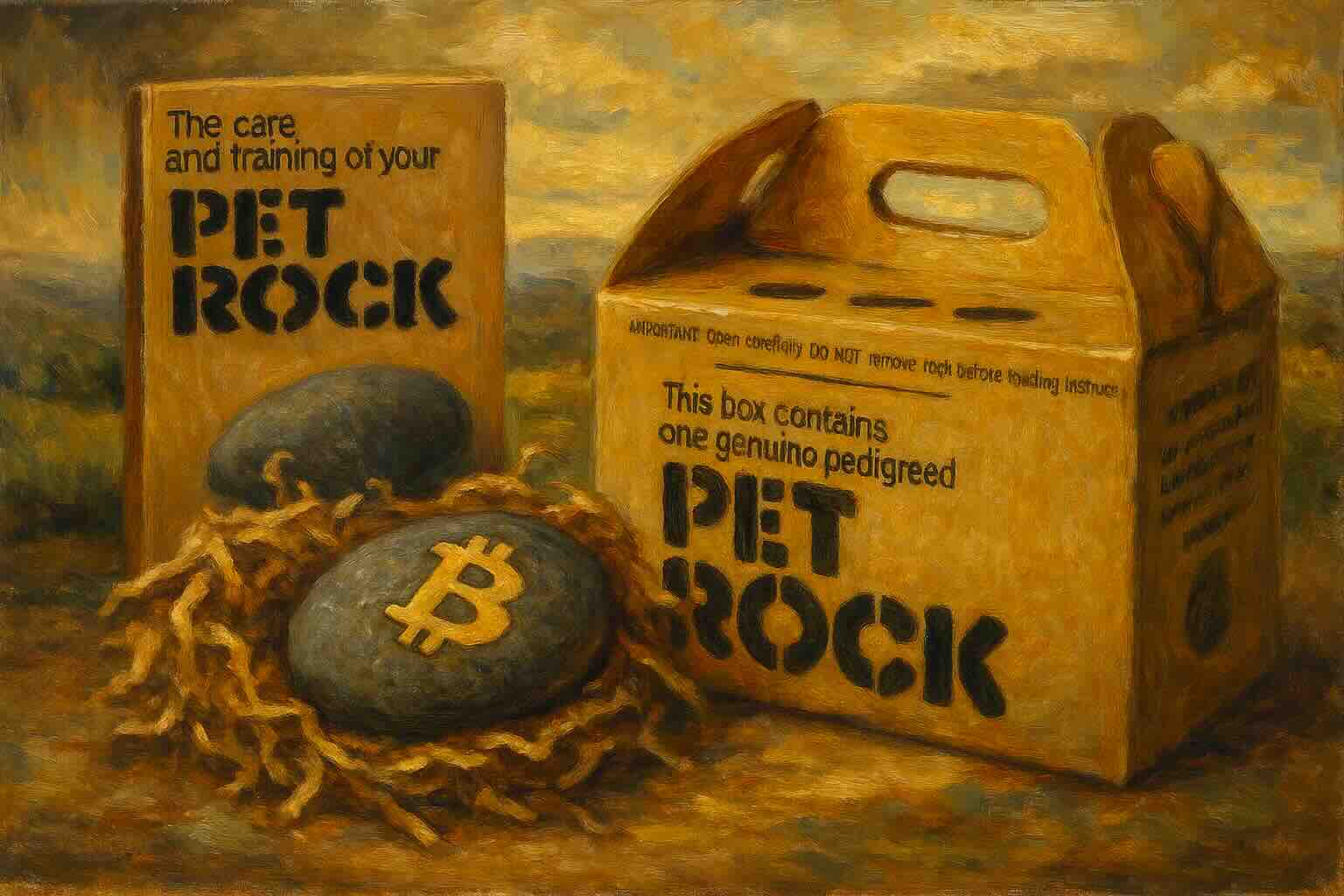
The Pet Rock phenomenon was a brief yet bizarre moment from August 1975 to February 1976. In that time, Gary Dahl, the inventor, sold an astonishing $5.9 million worth of Pet Rocks (that's approximately $34.5 million in today's dollars).
Marketed as the ultimate low-maintenance companion, the Pet Rock required no feeding, walking, or vet bills—it simply was. Despite its initial charm as a novelty, the Pet Rock quickly revealed its lack of real value or utility.

Today, JPMorgan CEO Jamie Dimon argues a new Pet Rock exists. This time, it's digital, permeating financial markets, and known as Bitcoin. Beyond peer-to-peer transfers, Bitcoin's utility, according to Dimon, is limited.
Unlike gold, Bitcoin isn't a physical commodity; unlike a dividend stock, it's not yield-bearing; and unlike Ethereum's native token ether, it doesn't power a decentralized application ecosystem. Bitcoin, in his view, merely appreciates based on its "digital gold" narrative.
But what if Bitcoin could be more than a Pet Rock? What if it could become a productive, income-generating asset? The good news: it can. The not-so-good news is accessing this productivity isn't as simple as buying an ETF or holding bitcoin on Coinbase.
Unlocking Bitcoin's true productive potential requires a deeper dive into the complex, yet rewarding, world of decentralized finance (DeFi). When you’re working with DeFi, a strong understanding of blockchain protocols, smart contracts, and associated risks is key.
For the investor willing to navigate this frontier, here are 4 ways to turn your Bitcoin into both an appreciating and income-generating asset.
How To Turn Your Pet Rock Into An Income Engine
Before jumping in, it's crucial to understand that the Bitcoin network doesn’t natively support the most common ways to earn yield on your bitcoin. To leverage DeFi's full potential, you'll often need to “wrap” your bitcoin into a tokenized version for use on other networks.
This “wrapping” process exchanges your bitcoin for a 1:1 representation, known as wrapped bitcoin (WBTC). Think of it like trading in $100 cash for a $100 chip at a casino. WBTC can be used to earn yield on networks like Ethereum, just like casino chips can be used to play games at the Bellagio. When ready, you always have the flexibility to swap the WBTC back to bitcoin.
Many platforms and apps provide their own variation of WBTC. For example, Coinbase allows you to wrap your bitcoin into Coinbase BTC (cbBTC). CbBTC follows the same principles as WBTC, just with a different platform facilitating the tokenization process.
With that topic covered, let’s review four ways you can earn yield on your bitcoin using DeFi.
1. Lending on Decentralized Lending Protocols
How it works: You deposit your wrapped bitcoin into a decentralized lending protocol like Aave or Compound. Borrowers take out collateralized loans, and you earn interest (expressed as APY) on your deposited wrapped bitcoin.
Typical Yields: Less than 1% APY on popular platforms, although yields can spike during periods of high demand.
Risks:
Liquidation Risk: While borrowers are typically required to over-collaterize their loans, extreme market volatility could lead to a cascade of liquidations, and a loss of funds for the lender.
Smart Contract Risk: The underlying code of the lending protocol could contain bugs or vulnerabilities that hackers could exploit, leading to a loss of funds. This is a common risk throughout DeFi protocols and with crypto in general. Smart contract risk applies for all the methods we detail below too, so we won’t repeat this risk for brevity sake. The most reputable DeFi protocols mitigate this risk by having robust testing, third-party smart contract audits, and even bug bounty programs to address vulnerabilities found after release.
2. Providing Liquidity to Decentralized Exchanges (DEXs)
How it works: You deposit a pair of assets into a liquidity pool on a decentralized exchange like Uniswap or Curve. A decentralized exchange enables trading to happen peer-to-peer rather than through a centralized intermediary like Coinbase. The liquidity you provide facilitates trading between those assets, and you earn a share of the trading fees on that asset pair.
Take an example where you deposit the following asset pair into a liquidity pool: WBTC and cbBTC. Any time someone trades cbBTC for WBTC or WBTC for cbBTC, you earn a share of the trading fees.
Typical Yields: Just like decentralized lending, liquidity pool yields are dynamic and will depend on the asset pairs you provide liquidity for on the platform. In the example above (WBTC/cbBTC), yields might fluctuate between 0.5% - 2% APY. Pairing WBTC or ETH with a stablecoin like USDC can offer significantly higher yields (10-25% APY), though this introduces higher "impermanent loss" risk (see more on that below).
Risks:
Impermanent Loss: This is a unique risk when providing liquidity to a DEX. If the price of your two deposited assets diverges significantly after you deposit them, you might withdraw less total value than if you had simply held the assets separately. The loss is impermanent because it goes away if the asset prices return to their original price ratio before you withdraw your funds.
Providing liquidity for two assets pegged to the same cryptocurrency (ex: WBTC/cbBTC) should see little to no price divergence. An asset pair like WBTC/USDC has a much higher chance of price divergence since Bitcoin’s price is highly volatile relative to dollars. If you want to go deeper on how impermanent loss works, refer to this article from Binance, a leading crypto exchange.
Rug Pulls: Newer or unaudited DEXs carry the risk of developers abandoning the project and absconding with user funds. We recommend you only consider established DEXs like Uniswap.
3. Providing Collateral for Stablecoin Yield Farming
How it works: You can lock up your wrapped bitcoin as collateral in protocols like MakerDAO to mint decentralized stablecoins (e.g., DAI). These dollar-pegged stablecoins can then be deployed in other DeFi strategies to generate yield.
Typical Yields: In this case, the yield isn't directly on your bitcoin. Instead, it's generated from the stablecoins minted using bitcoin as collateral. Yields vary but tend to be higher than wrapped bitcoin since stablecoins can be used in a wider variety of use cases. Yields for a reputable decentralized stablecoin like DAI can be anywhere from 3-5% APY depending on demand or the yield strategy you implement.
Risks:
- Liquidation Risk: If the value of your bitcoin collateral falls below a certain threshold, your collateral can be liquidated to unwind the stablecoin position.
- Stablecoin De-peg Risk: While stablecoins are designed to maintain a $1 peg, unexpected events could cause a stablecoin to temporarily lose its peg. This would negatively impact the value of your assets and earned income.
4. Staking Via A Bitcoin Layer 2 Protocol
How it works: You deposit your bitcoin into a Layer 2 (L2) protocol like Babylon. Babylon allows people to build proof-of-stake applications on the Bitcoin network, just like in the Ethereum and Solana ecosystems. Validators use your bitcoin as collateral to confirm transactions for these applications, earning fees that are then passed to you as interest.
Typical Yields: Bitcoin staking is relatively new and still being developed. Yields currently hover between 1-1.8% APY depending on the service you decide to stake with (e.g. Kraken or Lombard Finance).
Risks
Slashing Risk: Depending on the specific implementation of the L2 and the chains it secures, there might be a "slashing" mechanism where a portion of your staked bitcoin could be forfeited if the validator you're delegating to acts maliciously or experiences significant downtime.
Liquidity Risk: Your staked bitcoin may be locked for a certain period, potentially limiting your ability to access it immediately if market conditions change or you need to liquidate your holdings.
Wrapping Up
The DeFi ecosystem offers effective solutions to address Bitcoin's Pet Rock problem. By engaging with DeFi, you can transform Bitcoin from a mere appreciating asset into one that generates income too. However, navigating these protocols is challenging and not suitable for all investors.
For those willing to navigate DeFi's complexities, unlocking Bitcoin's productive potential is a powerful way to boost returns. While risks are inherent, a strong understanding of blockchain protocols, smart contracts, and their associated risks empowers you to transform that Pet Rock into a true income engine.
About Triple Point Strategy
Triple Point Strategy is a research firm and crypto investment manager. We operate the Marietta DeFi Fund, a crypto investment fund that is focused on capital appreciation and DeFi-native income strategies. It is currently available to U.S. accredited investors. Subscribe below to receive our latest insights directly in your inbox.
For U.S. accredited investors only. Offered under Rule 506(c) of Regulation D. This content is for informational purposes only and does not constitute financial, investment, or tax advice. This is not an offer to sell or a solicitation to buy any security. Any investment may only be made through the Fund's confidential offering documents. Investing involves risk, including possible loss of capital. Digital assets are volatile and subject to changing regulations.