Key Takeaways
Ethereum’s moat keeps deepening: Ethereum’s credible neutrality, vast developer base, and ever-growing liquidity dwarfs every other smart-contract chain, leaving “faster” rivals with little room to compete
Four heavily funded “Ethereum killers”(NEO, ADA, EOS, DOT) share one fate: Together they raised more than $5 billion with the promise of superior performance. Today, they command less than 1% of the DeFi ecosystem, showing that technological advances without network effects lead to stagnation.
The hype cycle repeats: New challengers such as Solana, Aptos, and Sui are recycling the same high-TPS headlines and war-chest narratives, while each Ethereum upgrade erodes their few remaining selling points before they reach critical mass.
Investors should follow the flywheel, not the flash: Sustainable value accrues where developers, users, and capital compound; so far, only Ethereum has proven that it can convert incremental improvements into enduring dominance.
How Ethereum earned (and keeps) the crown
Since launching in 2015, Ethereum has been the blockchain platform everyone wants to beat. Its initial fundraising was open and decentralized, attracting support from thousands of small investors. Ethereum’s key innovation—permissionless, self-executing code referred to as smart contracts—led to entirely new markets such as tokens, NFTs, and powerful decentralized applications. By the end of the 2010s, Ethereum was second only to Bitcoin in market value, but was clearly first in developer interest. The Ethereum network powered both the Initial Coin Offering (ICO) boom of 2017 and the Decentralized Finance (DeFi) explosion of 2020.
That success immediately drew copycats. Investors who missed Ethereum’s meteoric rise hunted for the “next Ethereum,” pouring billions into fresh smart contract projects labeled as “Ethereum killers.” These upstarts promised higher throughput, lower transaction fees, and slicker developer tooling. All were fueled by giant private rounds that handed venture capitalists large early stakes—an opportunity Ethereum’s widely distributed supply never offered. Owning 20 percent of a new token supply at pennies on the dollar beats buying ETH on open markets, so term sheets filled up fast. Media hyperbole amplified the storylines, stoking FOMO and speculative capital.
However, unseating Ethereum proved far tougher than the glossy pitch decks promised. Ethereum’s early advantages included:
Strong network effects: An enormous community of developers, widely used standards like ERC-20, and deep pools of liquidity kept people building on Ethereum.
Scaling while maintaining decentralization: Ethereum has continued to scale by shifting high-volume transactions to its Layer-2 ecosystem. While doing this, it has also been able to maintain the security, decentralization, and credible neutrality that makes Ethereum so attractive to build on.
Strategic protocol upgrades: The shift to proof-of-stake in 2022 dramatically lowered energy use and increased network capacity. High fees once common on Ethereum became more manageable as transactions moved off-chain, and mechanisms like EIP-1559 turned network usage into a deflationary advantage for ETH holders.
Rivals stumbled on the same obstacles as Ethereum, and superior tech on paper proved unable to uproot an economy already entrenched with stablecoins, NFTs, and familiar financial technologies. Many contenders launched at multibillion-dollar valuations only to watch usage evaporate once early hype met the reality of immature tooling, thin user demand, and centralization trade-offs. Ethereum’s open-source culture and proven security kept builders and capital anchored where the deepest liquidity already lived, reinforcing the very moat challengers hoped to breach.
The tally is plain: self-proclaimed “Ethereum killers” have, at best, carved out modest niches rather than dethroned the leader. In our research brief, we revisit four of the most ambitious attempts (NEO, Cardano, EOS, and Polkadot) to see what they promised, how they launched, and why reality diverged from the hype. Their stories offer lessons, and a warning, for the latest crop of challengers now eyeing Ethereum’s crown.
They promised, they flew, they tanked
NEO
NEO started as AntShares in 2014 and rebranded in 2017, pitching itself as China’s answer to Ethereum. It bragged about a “faster, government-friendly” design and let developers code in familiar languages like C# and Java. Headlines hyped a “Chinese Ethereum killer,” complete with visions of state backing and “millions of transactions per second (TPS).” Investors chased the dream: a token sold for pennies in 2016 soared to a triple-digit price just 18 months later.
Unfortunately for NEO, progress relied on a tiny council and a messy network upgrade that confused users. As Ethereum’s open ecosystem kept pulling in builders and capital, NEO’s momentum evaporated. By mid-2025, the onetime challenger drifts near $5 (about 97% below its peak) and is now more cautionary tale than successor.
Cardano (ADA)
Cardano began in 2015 as an academic project led by Ethereum co-founder Charles Hoskinson and went live in 2017. It promised a greener proof-of-stake engine and a modular design to fix Ethereum’s slow, costly traffic. The press hailed a “scientifically proven Ethereum killer,” and investors piled in, pushing ADA from fractions of a cent to about $3 by late 2021.
However, smart-contract tools rolled out in slow, committee-guided phases that frustrated builders. Developers moved to faster-moving Ethereum rollups while Cardano kept debating research and votes. By mid-2025, ADA drifts near $0.60 (about 80% below its peak), showing that replacing Ethereum is easier to promise than to deliver.
EOS
EOS erupted in 2017 by raising $4 billion through its ICO. The protocol promised to be faster, cheaper, and more business-friendly than Ethereum. Slick promos dubbed it “Ethereum, but free,” and investors bought in, sending the token from about $1 to $21 and pushing EOS into crypto’s top five assets by market capitalization.
Then the cracks showed: decisions were made behind closed doors, accounts were frozen, and bitter fights erupted over the giant treasury. Builders lost patience and migrated to more open ecosystems while Ethereum kept compounding users and apps. Conference buzz faded, upgrades slowed, and daily activity dwindled. By mid-2025 EOS trades around $0.80—roughly 95% below its peak—a cautionary tale that money and marketing can’t replace organic adoption.
Polkadot (DOT)
Polkadot began in 2016 when Ethereum co-founder Gavin Wood imagined a network of many blockchains that could talk to each other. It finally launched in 2020 with a central Relay Chain and “parachains” meant to run side by side, skirting Ethereum’s network congestion. The story was compelling: specialized chains that share security and scale horizontally. Investors bought in. DOT debuted around $3 and rocketed to $55 in 2021, briefly vaulting Polkadot into crypto’s top tier.
However, securing a parachain slot was costly, the tooling felt academic, and cross-chain moves often broke, slowing real adoption. Meanwhile, Ethereum rollups offered simpler scaling and kept the users and liquidity that builders craved. By mid-2025, DOT drifts near $4 (about 90% below its peak), admired more for its white papers than for everyday apps.
Challengers follow a pattern
For eight years, project after project has claimed it would replace Ethereum. They raise huge sums, grab headlines, and then fade when real adoption never arrives. Several common patterns explain why this cycle repeats:
Network effects beat specs: Ethereum’s community momentum is hard to match. Ethereum’s real advantage is its people: hundreds of thousands of developers, millions of users, and the deepest liquidity in crypto. A newcomer might process transactions faster or cheaper, but rebuilding that community and capital from scratch is onerous.
Hype often peaks before products are ready: Projects like EOS, which raised $4 billion, and Cardano, briefly valued at $90 billion, rose dramatically based on big promises. When the expected apps, revenue, and daily users failed to appear on schedule, prices and attention fell just as sharply as they had risen.
Ethereum continues improving: Layer-2 rollups, the 2022 shift to proof-of-stake, and upcoming sharding upgrades have steadily lowered fees and boosted speed without forcing users to leave the ecosystem. Every improvement erodes a rival’s main selling point, because builders can stay on Ethereum and still gain the performance they need.
Decentralization and neutrality attract investment: Ethereum’s commitment to decentralization and credible neutrality makes it trustworthy for users, developers, and institutions. This helps Ethereum resist censorship and central control, making it appealing for long-term investment.
New chains lack a killer use case: Ethereum’s breakthrough was programmable finance; rivals have tried to clone the same DeFi experience instead of owning a new domain—gaming, supply chains, or something big. Without that fresh anchor, they won’t pull in builders, users, or liquidity.
Recently, Solana, Aptos, and Sui have stepped up as the latest “Ethereum killers,” but their challenges look familiar. Their marketing—“50,000 TPS,” “sub-second finality,” “infinite scalability”—mirrors EOS’s million-TPS boast and Cardano’s peer-reviewed perfection. Each chain has raised huge war chests and skyrocketed in value before shipping a breakout app, replaying the “hype-first, utility-later” pattern that felled earlier contenders. Meanwhile, Ethereum rollups already cut fees to fractions of a cent. Its shift to proof-of-stake adds strong, incentive-driven security, and forthcoming sharding upgrades keep the roadmap on track. As a result, speed and cost alone do not give rivals an edge. Most important, Ethereum’s network effects compound daily. Unless these newcomers can quickly match that community gravity and land a must-have application that anchors users, they’re likely to join the long list of aspirants who threw punches that Ethereum barely felt.
Wrap-Up
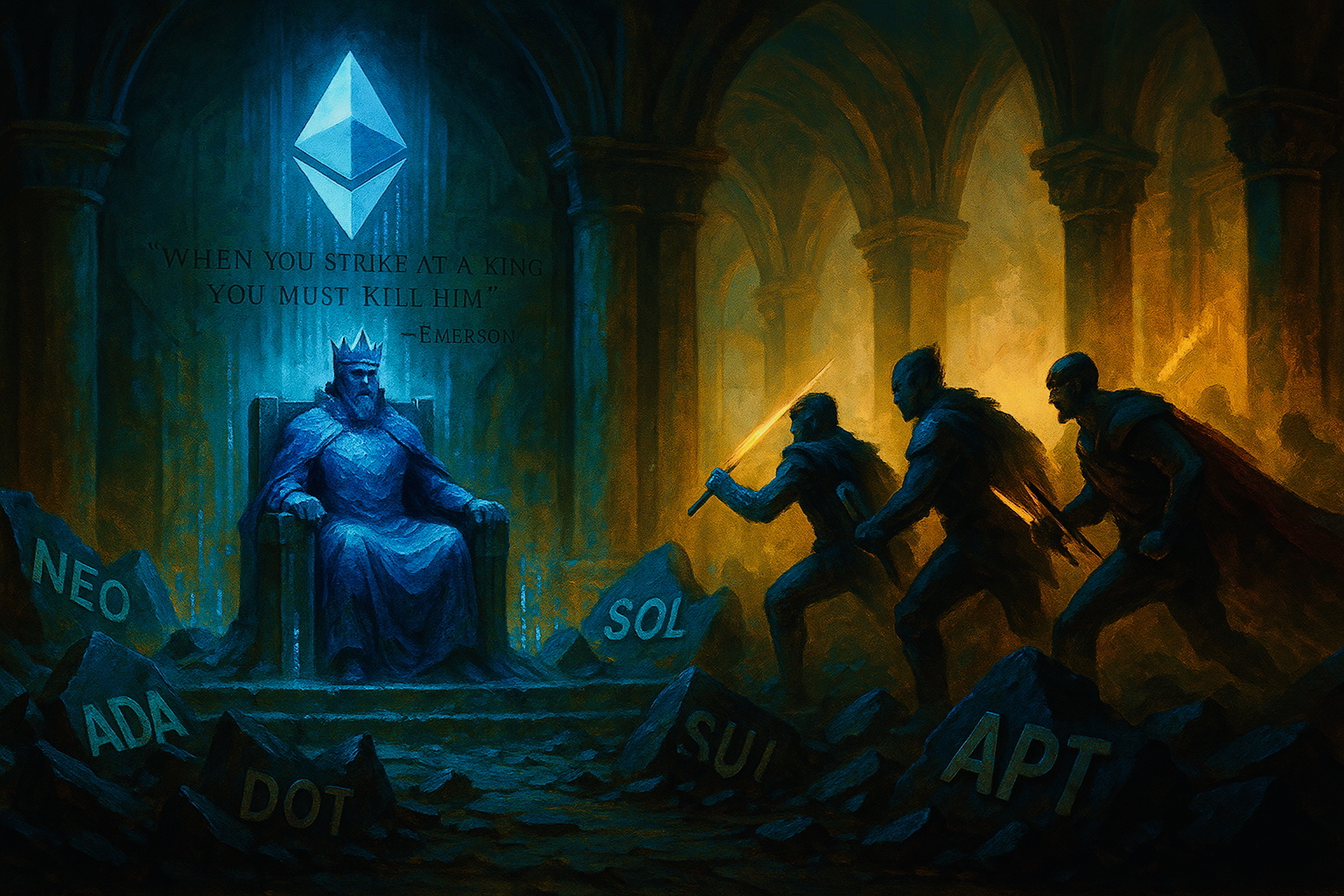
Most “Ethereum killers” fade not for lack of ambition, but because unseating a moving target with the deepest roots in crypto is hard. History is littered with big promises and thin results. Ralph Waldo Emerson put it plainly: “When you strike at a king, you must kill him.” Half-measures rarely topple a monarch who keeps improving.
At Triple Point Strategy, we read market cycles the way historians study empires. With every new blockchain, we ask a simple question: does it solve a problem Ethereum cannot? So far, the data says no. Ethereum still owns the largest talent base, deepest liquidity, and quickest pace of innovation. Until the numbers change, most of our capital stays with the chain that drives onchain activity and value capture; however, we stay ready to pivot the moment a true rival emerges.
About Triple Point Strategy
Triple Point Strategy is a research firm and crypto investment manager. We operate the Marietta DeFi Fund, a crypto investment fund that is focused on capital appreciation and DeFi-native income strategies. It is currently available to U.S. accredited investors. Subscribe below to receive our latest insights directly in your inbox.
For U.S. accredited investors only. Offered under Rule 506(c) of Regulation D. This content is for informational purposes only and does not constitute financial, investment, or tax advice. This is not an offer to sell or a solicitation to buy any security. Any investment may only be made through the Fund's confidential offering documents. Investing involves risk, including possible loss of capital. Digital assets are volatile and subject to changing regulations.