Key Takeaways
- Some analysts argue the U.S. is pursuing a “stealth default” by using inflation to erode the real value of its debt.
- The dollar ultimately runs on trust in institutions, and history shows that trust can break quickly when fiscal discipline weakens.
- Digital assets offer an alternative trust model: transparent ledgers and rule-based supply set by code, not policymakers.
- Holding assets outside the banking system can diversify counterparty risk and provide a hedge against financial repression or capital controls.
Why Investors Fear A Debased Currency
The United States is spending far more than it earns. Trillion-dollar deficits have become routine, and the national debt now exceeds $38 trillion. Servicing that debt is getting painfully expensive. In 2025, interest payments on the debt are projected to climb to roughly $1 trillion, rivaling the largest single line items in the federal budget. With debt still rising and interest rates no longer near zero, those costs are soaring.
If you are an investor, you might ask, “How will we pay for all this?” The United States’ answer appears to be to inflate the debt away. In other words, let the dollar’s value erode through higher inflation so that past debts become easier to handle. Some economists view this approach as a prolonged and stealthy default: paying creditors back in currency that is worth less.
Respected investors in traditional finance are also sounding the alarm and hedging against currency “debasement.” One of the most influential is Ray Dalio, founder of Bridgewater Associates. He has publicly warned that rapid borrowing and persistent deficits are devaluing fiat money and advises holding a modest share of a portfolio in gold and bitcoin as a hedge against the dollar losing value. Dalio is known for pragmatic investing, and his view is that serious investors should own at least some “sound money” assets as protection.
History’s Cautionary Tales: When Money Dies
History offers many clear cases of governments weakening their own money to escape heavy debts. Let’s look at three well-known examples and the consequences of currency debasement.
Roman Empire (1st to 3rd Centuries CE)
In Ancient Rome, emperors gradually reduced the silver content of coins to fund wars and public spending. Nero began this process by lowering the purity of the denarius. Over the next two centuries, later emperors continued to dilute the currency, replacing silver with cheaper metals such as copper and tin.
As silver content fell, prices rose and trust in money declined. Markets functioned less well as tax collection weakened and trade slowed. By the mid-third century, the Roman currency had lost most of its value. The economic ripple effects were severe. Savings evaporated and merchants demanded payment in goods rather than coins. Even the military felt the strain as soldiers’ pay lost value and loyalty shifted toward whichever general could actually afford to pay them. Economic instability spread through the empire and the currency became close to useless.
Weimar Germany (1920s)
After World War I, Germany struggled with heavy reparations and a damaged economy. The government resorted to printing money to meet its financial obligations, which pushed the country into hyperinflation.
By 1923, prices rose at extreme speed. Savings collapsed, wages fell behind rising costs, and businesses could not plan beyond a few days. Many families lost everything they had stored in bank accounts. The broader economy became chaotic. Trade slowed, foreign suppliers refused to accept the German mark, and social tensions increased. The currency ultimately collapsed and became functionally worthless, destroying the middle class and wiping out generational wealth that had taken decades to build.
Zimbabwe (2000s)
During the 2000s, Zimbabwe faced a deep economic crisis with falling production, high unemployment, and growing government debts. To cover its expenses, the government created more money. This triggered one of the most extreme episodes of hyperinflation in modern history.
Inflation reached astonishing levels. Prices doubled within hours, and banknotes with massive numbers appeared in circulation. Businesses stopped accepting the local currency, workers demanded foreign money, and ordinary people were forced to use barter or U.S. dollars to buy food. In the end, the Zimbabwean dollar failed completely. The currency was abandoned because it could no longer serve any useful purpose, and the wealth stored in it was wiped out.
Echoes of Today: Is The U.S. On A Similar Path?
Throughout these historical cases, we see that excessive debt leads governments to expand the money supply. The dilution of currency weakens trust and raises prices. When this continues long enough, the currency collapses and the wealth tied to it is destroyed. This raises a natural question: Is the United States headed down the same path?
So far, confidence in the U.S. dollar endures. Investors still flock to it in times of crisis. Yet confidence is fragile. Debt is at record highs and climbing faster each year. Interest costs are rising sharply, consuming nearly a trillion dollars annually. Political gridlock makes meaningful deficit reduction difficult. The temptation to rely on inflation to lighten the debt burden is growing. In recent history, the British pound held the same privilege that the U.S. dollar does today. Over time, chronic deficits and overextension eroded that dominance. The same forces could someday challenge the dollar’s supremacy if discipline continues to slip.
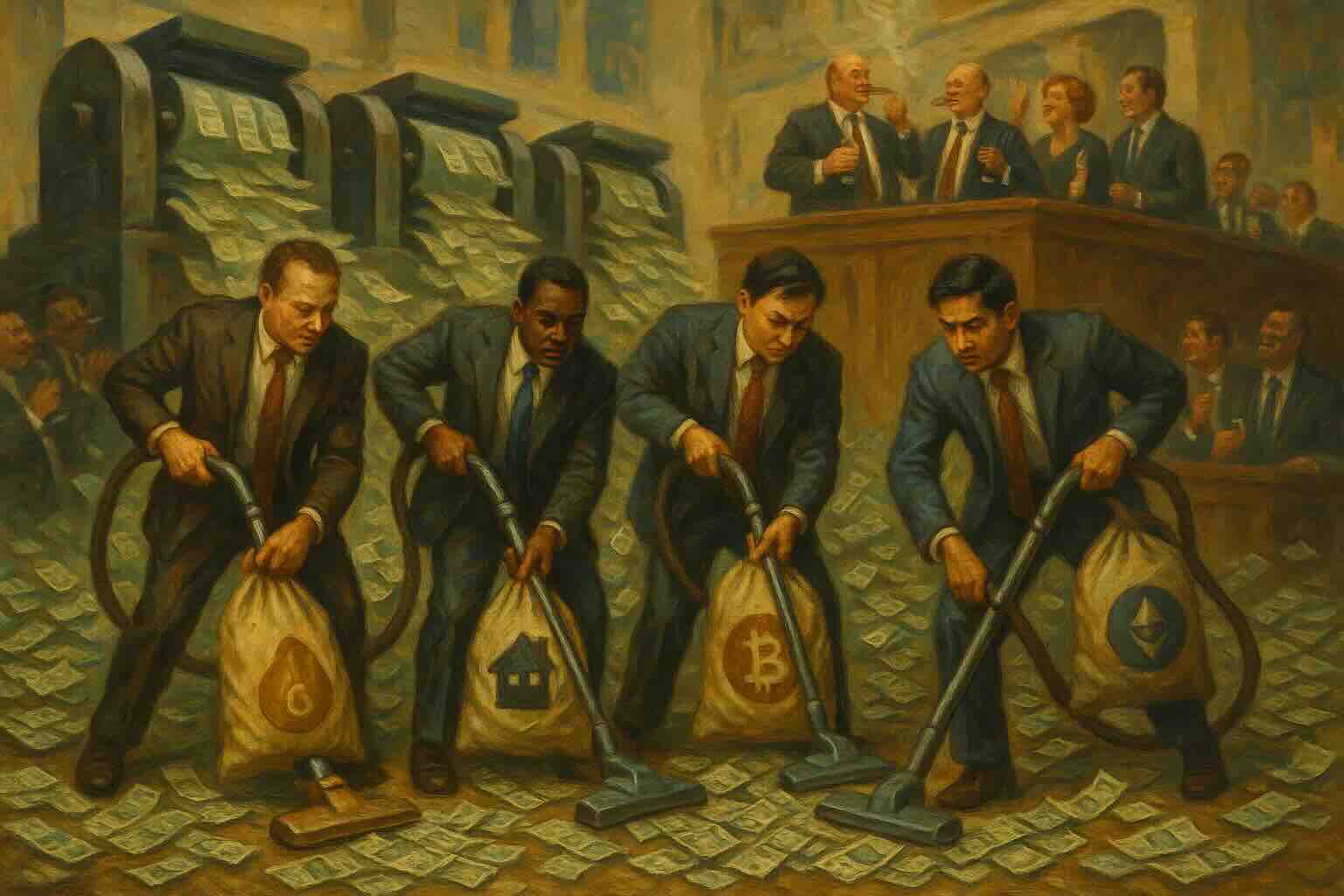
Market analysts have started using a phrase to describe how investors are reacting to this situation: the debasement trade. It refers to investors gradually shifting their portfolios away from government-issued currencies and government debt toward hard assets such as gold, real estate, and crypto.
Why Crypto Belongs In The Debasement Trade
Gold has long been the classic hedge against reckless policy and weakening currencies. In the twenty-first century, crypto has emerged alongside it. Assets such as bitcoin and ether offer a way to step outside the potential blast radius of a failing U.S. government or Federal Reserve. Four qualities make them particularly relevant in that context.
Separation of money and state
The U.S. dollar is managed by human institutions. Congress runs deficits, the Treasury issues debt, and the Federal Reserve adjusts interest rates and expands or shrinks its balance sheet. In practice, this means the supply of dollars can grow quickly when political or financial pressures demand it. There is no fixed cap on how many dollars can exist.
Bitcoin was built as a direct contrast to that model. Its monetary policy is set in code, with a maximum supply of twenty-one million coins. That limit does not change if the United States runs larger deficits or if the Fed needs to stabilize markets. Ethereum follows a similar idea, with issuance rules defined and updated by its network rather than by a single government.
This creates a clear distinction. The dollar is tied to U.S. fiscal and monetary decisions. Bitcoin and Ethereum exist outside that process. For investors who worry that future U.S. policy could erode the value of the dollar, this separation is the core reason crypto appears in the debasement trade.
Trust but verify
The U.S. financial system is built on trust in data provided by institutions. Dollar users rely on data from the Federal Reserve, commercial banks, regulators, and government agencies. Money supply figures, bank balance sheets, and inflation statistics are all reported after the fact. Most people cannot independently verify what is happening inside the system. They accept that the numbers are accurate and that the rules will be applied fairly.
Crypto takes a different approach. Every transaction and every unit of bitcoin or ether is recorded on a public ledger. Anyone can verify total supply, movement of funds, and the rules that govern the system. There are no special reporting windows or privileged insiders who see a different set of books.
In a world where the value of the dollar depends on the judgment of a few key institutions, this level of transparency matters. It gives investors a way to hold part of their wealth in a system where monetary facts can be checked directly rather than inferred from official reports.
Technology that mitigates counterparty risk
Dollar assets usually sit inside the banking and capital markets system. They depend on intermediaries such as banks, brokers, and custodians. These intermediaries can fail, restrict withdrawals, or face political pressure. The United States has strong legal protections, but recent history still includes bank failures and targeted account freezes.
Crypto assets work differently. Ownership is controlled by private keys and secured by cryptography and distributed consensus. There is no single authority that can arbitrarily inflate the supply, rewrite balances, or decide that certain holders no longer have access. The network itself enforces the rules.
For investors who worry that rising U.S. debt might lead to more aggressive financial repression, capital controls, or stealth taxes on dollar savings, this structure offers a form of insurance. Crypto cannot remove all risk, but it shifts a portion of wealth into a system that is less exposed to the same policy tools that affect the dollar.
Store of value qualities
The U.S. dollar is the world’s reserve currency, backed by the “full faith and credit” of the United States government rather than by a fixed supply of money or a direct claim on real assets. That backing has been powerful for decades, but it is still a political promise made by a single nation-state. Like empires before it, that promise can be strained by rising debts, political gridlock, or a loss of fiscal discipline. The dollar is not designed to be scarce, and over long periods inflation reduces its purchasing power. U.S. bonds and savings accounts can offset some of this, yet real returns often fall when rates stay below inflation or when policy leans toward supporting borrowers over savers.
Bitcoin and Ethereum approach the store-of-value problem from a different angle. Both are global assets with no central issuer and no dependence on the creditworthiness of a single government. Bitcoin emphasizes programmed scarcity. Its supply is capped, its monetary policy is enforced by open-source code, and its security comes from a distributed network of participants rather than a central bank. This makes it akin to digital gold that is hard to create, easy to store, and simple to move across borders. Ethereum functions more like digital infrastructure. Ether powers a worldwide network of applications that handle payments, lending, trading, and other services onchain, secured by validators distributed across many jurisdictions. Owning ether is closer to holding a stake in a growing global computational economy than to holding cash or a claim on one country’s balance sheet.
Beyond bitcoin and ether, other digital assets support specific parts of this new onchain economy. Each one derives value from verifiable scarcity or real utility inside its own system. Together, they give investors tools to diversify away from exclusive reliance on the U.S. dollar and the promises of any single nation-state at a time when concerns about debt and monetary debasement are rising.
A Hedge, Not A Short
Owning crypto in the face of monetary debasement is about prudence. You do not need to believe the dollar will fail to see the logic in holding an asset that operates under a different set of rules.
Crypto can serve the same role that gold and real estate do: a modest allocation that hedges against policy mistakes and long-term inflation. The difference is that crypto exists entirely in digital form and can be audited, transferred, or stored anywhere in the world at any time.
Access has become easy. You can now buy bitcoin and ether through regulated spot exchange-traded funds, institutional custodians, or direct ownership. Allocations can be small. Even a few percentage points of exposure can serve as an insurance policy against the erosion of purchasing power.
Diversification is ultimately the heart of the debasement trade. By holding assets that function under different assumptions, you are protecting yourself from the possibility that one system’s assumptions fail.
Conclusion
Currency debasement is one of the oldest tricks in the book. It has rescued governments in the short term and ruined them in the long term. From Rome’s fading silver to Weimar’s printing presses and Zimbabwe’s runaway notes, history shows what happens when money becomes a political tool.
While it is unlikely that the United States is on the verge of hyperinflation, the incentives to dilute the currency are real. In a world where money is increasingly subject to politics, holding assets governed by code is one way to ensure that part of your wealth remains outside the danger zone of fiat collapse.
About Triple Point Strategy
Triple Point Strategy is a research firm and crypto investment manager. We operate the Marietta DeFi Fund, a crypto investment fund that is focused on capital appreciation and DeFi-native income strategies. It is currently available to U.S. accredited investors. Subscribe below to receive our latest insights directly in your inbox.
For U.S. accredited investors only. Offered under Rule 506(c) of Regulation D. This content is for informational purposes only and does not constitute financial, investment, or tax advice. This is not an offer to sell or a solicitation to buy any security. Any investment may only be made through the Fund's confidential offering documents. Investing involves risk, including possible loss of capital. Digital assets are volatile and subject to changing regulations.