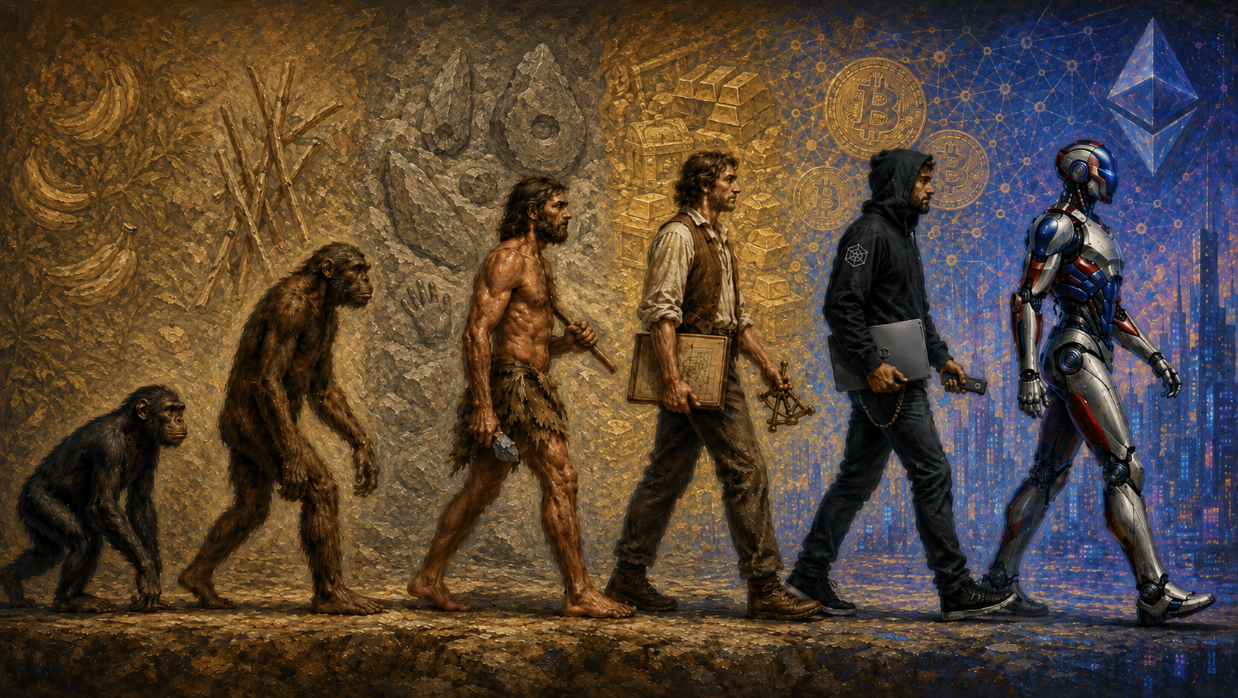
Crypto Is For Humans And Machines: How AI Expands Crypto's Opportunity
Key Takeaways
- The investment case for crypto has always been built around human adoption. That framework is about to expand. AI agents are emerging as a new class of economic participant, and they need financial infrastructure that the traditional banking system cannot provide.
- For people, crypto offers a better financial system. For AI agents, crypto offers the only financial system that scales to the full range of machine commerce. That distinction between improvement and necessity changes how the opportunity should be sized.
- Both human users and AI agents are converging on the same crypto infrastructure. Protocols that serve both audiences benefit from compounding demand, and the combined addressable market is larger than any human-only model reflects.
A Familiar Pattern
In the nineteenth century, America's railroad networks were built to move freight and military resources across long distances. That was the original use case, and it justified the enormous capital required to lay track across the continent. What the original investors and engineers did not anticipate was how dramatically the user base would expand once the infrastructure was in place. Passenger travel emerged as a major second market, and entire real estate economies eventually reshaped themselves around rail access.
More than a century later, Apple followed a similar pattern. In January 2007, Steve Jobs introduced the iPhone as three products in one: a widescreen iPod, a revolutionary mobile phone, and a breakthrough internet communications device. In doing so, Apple delivered infrastructure for products that did not yet exist. Uber, DoorDash, Airbnb, Instagram, and Venmo all arrived once the right builders and users found the platform.
This pattern, where infrastructure is built for one audience and then finds a second, much larger audience, has played out across centuries and industries. The investors who benefit most are typically the ones who recognize the expansion early, before the market has fully adjusted its models to account for the new demand.
The crypto industry appears to be approaching one of these moments right now. For over a decade, the entire investment case for digital assets has been built around human adoption: how many people hold Bitcoin, how many institutions have allocated to crypto, how fast stablecoin usage is growing among consumers and businesses. These are valid metrics and they reflect material progress. But they share a premise that has gone largely unexamined. These metrics are built on the assumption that the only users of crypto infrastructure will be humans. That assumption is about to become incomplete.
An Upgrade for People, a Necessity for AI
The case for crypto as a financial system for human users is well established and continues to strengthen. However, adoption has followed a gradual curve precisely because it is a choice between competing systems. The incumbent system, for all its limitations, has decades of infrastructure and trust behind it.
The picture looks fundamentally different for AI agents. An AI agent is software that can make decisions and transact on behalf of a user or on its own. These agents are already operating in the real world through products like OpenClaw and Hermes Agent. As their capabilities grow, so do the volume and complexity of economic activity they generate. The challenge these agents face is that the traditional financial system was designed for humans, and it requires human identity at every layer. Opening a bank account requires government-issued identification and Know Your Customer verification. Payment processors will not touch an account that is not tied to a verified individual or legal entity. Credit card networks typically require a cardholder to have a credit history.
Crypto has no such requirements. A wallet can be generated from a cryptographic key pair in seconds, with no identity verification or approval from a financial institution. Once that wallet exists, it can send and receive payments, interact with smart contracts, and participate in decentralized financial protocols anywhere in the world, at any time. For AI agents operating at machine scale, there is a practical necessity for permissionless access. Crypto is the only financial system that supports the full range of agent commerce, from autonomous activity to micropayments to agent-to-agent transactions.
The infrastructure to support this is already being built. Coinbase launched wallets designed specifically for AI agents in February 2026 and developed an open payment standard called x402 that lets agents pay for services automatically using stablecoins. In April 2026, the Linux Foundation stepped in to govern x402 as an open standard, with backing from more than 20 major companies. The following month, Amazon Web Services launched Bedrock AgentCore Payments with Coinbase and Stripe, becoming the first hyperscaler to embed crypto micropayments natively into its own managed AI agent platform. Warner Bros. Discovery is among the early enterprises testing it. The institutions building this infrastructure are treating agent commerce as a legitimate and growing market.
Two Economies, One Infrastructure
What makes this expansion particularly relevant for crypto investors is that human users and AI agents are converging on the same financial infrastructure.
Ethereum offers the clearest example. A person depositing into a lending protocol and an AI agent paying for compute resources move through the same systems and use the same tokens. This reality also applies to stablecoin payments, lending markets, and onchain exchanges. Agent activity layers new demand onto the human economy already running through these protocols, compounding their value.
The scale of the human crypto economy is already notable. According to Crypto.com's 2025 Market Sizing Report, global cryptocurrency ownership reached 741 million people last year, against a total market cap of roughly $3 trillion. The AI agent economy is much earlier but growing fast. MarketsandMarkets projects the global AI agent market will grow from roughly $8 billion in 2025 to over $50 billion by 2030\. McKinsey estimates that agentic commerce could account for up to $1 trillion in U.S. retail revenue by 2030, with global projections ranging from $3 trillion to $5 trillion. These two economies are developing on separate tracks, but they converge on the same rails, and that overlap is what makes the combined opportunity larger than either one alone.
The Year of Product-Market Fit
We have been watching the intersection of AI and crypto closely since 2024, when the first signals of product-market fit began to emerge. Experimental projects like Truth Terminal and Virtuals Protocol demonstrated that autonomous agents could interact with crypto rails in ways that generated real economic activity and community engagement. These were early prototypes, but they pointed clearly toward a future where software agents would need financial infrastructure to function, and where crypto was the natural fit.
Since then, the pace of development has accelerated significantly. The trajectory from proof of concept in mid-2024 to institutional infrastructure in early 2026 has been remarkably fast, even by technology standards. It follows a pattern that is familiar from how fintech innovation typically progresses: experimental use cases emerge, infrastructure providers take notice, standards form, and institutional capital follows.
Our Perspective
Those early signals in 2024 shaped how we think about capital allocation at Triple Point Strategy. We came away from that period with a conviction that AI agents were going to become meaningful users of crypto rails and that their activity would contribute to long-term growth across the protocols we invest in. That conviction became a core part of how we evaluated opportunities, and it shifted our investment lens from a purely human-centric view of crypto adoption to one that accounts for both.
Where we underestimated the situation was the pace. We expected the AI-to-crypto convergence to unfold over several years. The speed at which AI capabilities have advanced, and the speed at which agents have begun generating material economic activity that requires financial infrastructure, have outrun our original timeline by a significant margin.
That acceleration has also placed new demands on the underlying blockchains. Networks that want to capture both human and agent financial activity need higher throughput at lower cost than the human economy alone requires. Ethereum's ongoing progress on the blockchain trilemma, balancing security, decentralization, and scalability through its Lean Ethereum roadmap and Layer 2 ecosystem, is encouraging on this front. We believe the networks that solve this scaling challenge most effectively will be the ones that capture the largest share of the combined human and AI financial economy.
However, caution is warranted. Agent reliability remains inconsistent, regulatory frameworks for agent-driven commerce are largely nonexistent, and questions around liability, tax reporting, and sanctions compliance remain open. For long-term investors, though, the direction matters more than the exact timing. The institutional commitments already in place signal that the market for agent-native financial infrastructure is a question of when, not if. And because this stack is being built on top of existing crypto protocols, early positioning in those protocols captures optionality on the agent economy without requiring a bet on a specific timeline.
Although crypto was built for human finance, it is now becoming essential infrastructure for machine finance as well. The opportunity is compounding, and we firmly believe the market has not yet fully accounted for what that means.
About Triple Point Strategy
Triple Point Strategy is a research firm and crypto investment manager. We operate the Marietta DeFi Fund, a crypto investment fund that is focused on capital appreciation and DeFi-native income strategies. It is currently available to U.S. accredited investors. Subscribe below to receive our latest insights directly in your inbox.
For U.S. accredited investors only. Offered under Rule 506(c) of Regulation D. This content is for informational purposes only and does not constitute financial, investment, or tax advice. This is not an offer to sell or a solicitation to buy any security. Any investment may only be made through the Fund's confidential offering documents. Investing involves risk, including possible loss of capital. Digital assets are volatile and subject to changing regulations.