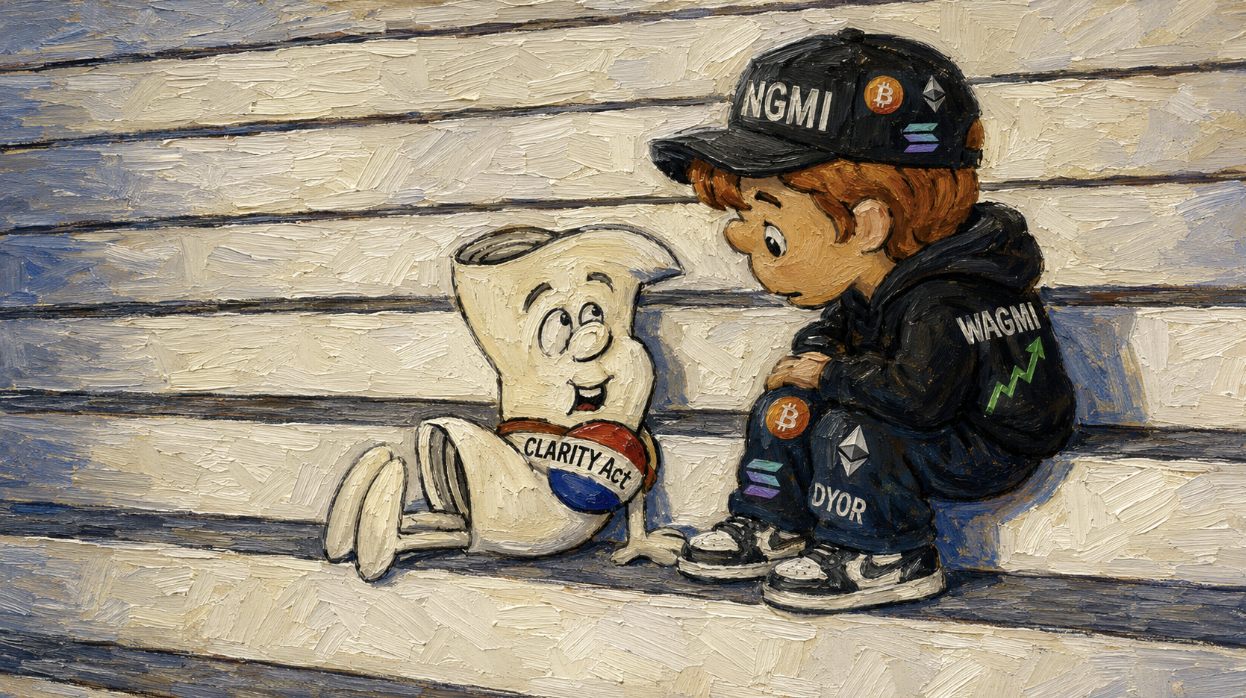
The CLARITY Act: What It Means for Investors
Key Takeaways
- The CLARITY Act splits oversight of digital assets between the SEC and the CFTC. It ends the jurisdictional fight that pushed builders and capital offshore for most of the past decade.
- Its central mechanism is the “mature blockchain system” test. A token can start under the SEC as a security and move to the CFTC as a commodity once certain criteria are met. Bitcoin and Ethereum clear the bar today, while many newer tokens do not.
- The bill pairs the custody and disclosure standards institutions require with carve-outs for non-custodial developers and self-custody. How far oversight of decentralized finance should reach is the one major question the Senate’s two versions still answer differently.
- The shape of the law has broad bipartisan support, while its timing does not. The House passed its version in July 2025, the Senate Banking Committee advanced its own in May 2026, and the obstacles that remain are political rather than structural. For investors, the direction of travel is clearer than the timeline.
The Last Time We Wrote These Rules
The last time the United States wrote foundational rules for a new kind of market, the year was 1933. The country was climbing out of a crash that had wiped out a generation of savings. The stock market had no agreed definition of a security, no disclosure standards, and no single authority policing any of it. Congress answered with the Securities Act of 1933 and the Securities Exchange Act of 1934. Those two laws did three things: defined what counted as a security, required issuers to disclose, and created the Securities and Exchange Commission (SEC) to enforce both. That framework has governed American markets for the ninety years since.
Digital assets have waited most of a decade for a comparable moment, and the CLARITY Act is the closest the industry has come. The bill amends those same two Depression-era statutes, along with the Commodity Exchange Act. It sets out to do the same three jobs for crypto that the 1930s laws did for stocks: define the asset, require disclosure, and assign a regulator to enforce the rules.
The legislation goes by a few names. The House version is the Digital Asset Market Clarity Act, known as the CLARITY Act, which passed last year. The Senate has been writing its own through two committees, the Banking Committee and the Agriculture Committee. A final law will have to merge those two Senate versions, then reconcile them with the House bill. CLARITY follows the GENIUS Act, the stablecoin law signed in July 2025, which makes market structure the second chapter of crypto’s regulatory build-out.
The first job of any such framework is to settle the question that has done the most damage to crypto by going unanswered: who is in charge?
Drawing the Line Between the SEC and the CFTC
For most of crypto’s history, the legal status of a token was a matter of opinion, and the opinion that counted depended on which agency was asking. The SEC treated most tokens as securities, the investment contracts that demand registration and disclosure. The CFTC treated the largest assets as commodities, closer to gold or oil. Both agencies claimed overlapping ground, and the boundary between them was never set in statute.
The CLARITY Act draws that boundary. It sorts digital assets into categories and assigns each to a single regulator. A token sold to raise money, where buyers are backing a team to build something, stays with the SEC as a security. A mature, decentralized network that no longer depends on any one company falls to the CFTC as a commodity. Stablecoins keep their own lane under the GENIUS Act, and the bill directs the two agencies to coordinate where their authority overlaps.
For an allocator, the first effect is the removal of reclassification risk from assets that are already widely held. A token that might be ruled a security tomorrow trades at a discount today, a regulatory risk premium that has quietly weighed on the whole category. Assigning each asset to one regulator lifts that premium. Knowing which agency oversees an asset is the starting point.
The next question is how that agency makes its rules, and whether a company can read them before it is sued under them.
From Regulation by Enforcement to Written Rules
For years, a crypto company could not learn which rules applied to it until a regulator decided after the fact. The SEC set the boundaries case by case, through enforcement actions brought after a firm had already launched. A founder learned where the line sat only after crossing it and facing a lawsuit.
The CLARITY Act replaces that pattern with rules written into statute. It creates registration paths for digital commodity exchanges, brokers, and dealers. It lets those firms operate under provisional registration while the agencies finalize the details. It also puts the SEC and the CFTC on deadlines to write those details, rather than leaving the market waiting indefinitely. A business can read the requirements, build to them, and know in advance whether it complies.
The effect reaches the supply of investable projects. Founders who incorporated offshore to escape the ambiguity gain a reason to build in the United States, where the rules are now legible. That deepens the pool of credible, domestically regulated projects an investor can underwrite.
A written rulebook tells an operating business how to behave. However, it leaves open the question that has followed the asset class since the first token sale. Must a token remain a security for its entire life?
How a Token Moves From Security to Commodity
This is the part of the bill that does the most original work, because it addresses a problem with no equivalent in traditional finance. A share of stock is a security for its entire life. A token can change. Early on, when a small team controls the code, the treasury, and the roadmap, a token resembles a bet on that team. Once thousands of independent participants run the network and no single party controls it, the same token behaves more like a commodity, an input the network consumes.
The CLARITY Act writes that distinction into law through what it calls a “mature blockchain system” test. A token can begin under the SEC as an investment contract asset, sold through a fundraise with the disclosures that implies. It can then transition to a commodity under the CFTC once its network meets the test for maturity. That test turns mainly on control. No single person or affiliated group can hold 20 percent or more of the token supply or its voting power. The code must be open, and the token must have a working use beyond speculation. Bitcoin, controlled by no one, has sat in the commodity category from the start. Ethereum began with a public sale and grew into a network no company commands, which makes it the clearest example of an asset that would complete the journey. Many newer tokens would not clear the bar yet, and would face a project-by-project review.
To make the early stage workable, the bill also creates a lawful way to raise capital. A U.S.-organized issuer can raise a capped amount each year under a token registration exemption, currently set in the tens of millions of dollars. The issuer must file an offering statement with the SEC and cannot let any single buyer take more than 10 percent of the supply. The law gives a project up to four years to reach maturity and requires disclosure every six months until it does.
For investors, the consequence shows up in how the next generation of projects gets funded. A defined, disclosed path to raise channels early capital into the open, where it can be evaluated, rather than into private deals and offshore vehicles. A token can leave securities treatment behind, but that only matters if the venues and custodians around it can be trusted. The framework pairs the maturity path with the standards that make the market safe to enter.
Custody Rules, DeFi Carve-Outs, and Who Can Invest
A market that wants institutional money has to cover three things at once: how customer assets are held, how the open and permissionless side of crypto is treated, and who becomes eligible to invest. The CLARITY Act addresses each.
Start with custody. For years, exchanges mixed customer assets with their own, disclosures were thin, and a run of high-profile failures kept conservative capital away. The bill requires customer assets to be held by qualified custodians and kept separate from a platform’s own funds. It mandates disclosure about how those assets are handled. It extends clear anti-fraud and anti-money-laundering authority across the market. These are the conditions a regulated institution needs before it can hold the asset class for clients.
The bill also protects the open side of crypto. Sections 309 and 409 carve out decentralized activity. People who write open-source software, run validators, or operate non-custodial infrastructure are not treated as financial intermediaries. The bill also protects the right to hold your own assets in a self-hosted wallet. This is the part that matters most to the lending protocols and oracle networks that decentralized finance runs on. The carve-out is not settled. The Senate’s two versions disagree on how far oversight should reach. The Banking Committee’s draft would extend anti-money-laundering obligations to some DeFi protocols. The Agriculture Committee’s version defers the question, and the treatment of non-custodial developers stays open as the two get merged. This is the one place the industry is still reading the text line by line.
The third effect is on who can invest. Pensions, registered investment advisers, and bank balance sheets can allocate to an asset class only once qualified custody and clear disclosure exist. The standards that protect customers double as the eligibility criteria that admit a much larger pool of capital. Taken together, the custody rules, the DeFi carve-out, and the new eligibility standards form a coherent and largely investor-friendly framework.
The Politics Holding It Up
For all its progress, the CLARITY Act is not law, and the obstacle has little to do with how crypto is regulated. The Senate Banking Committee advanced the bill on May 14, 2026, by a vote of 15 to 9. All thirteen Republicans were joined by Democrats Ruben Gallego and Angela Alsobrooks. Part of what remains is mechanical. The Senate’s two versions still have to merge. The combined bill then needs sixty votes on the floor, and the House has to accept the result or send it to a conference committee.
The harder part is political. A group of Senate Democrats will not support the bill without language barring government officials from profiting off the crypto industry while they regulate it. The dispute centers on the current administration’s crypto holdings. Republicans argue that existing federal ethics rules already cover the problem, pointing to Office of Government Ethics standards and section 208 of the federal conflict-of-interest statute. Democrats want the protection written explicitly into this bill. The provision also sits outside the committees’ formal jurisdiction, which complicates where it can be added at all.
Most observers expect a compromise before any floor vote. The White House has set a target of a signed bill by July 4, though the fight could push final passage past the 2026 midterms. Even in the best case, enforceable rules would not arrive until 2027, since the agencies need time to write them after the bill is signed. For an investor, the useful line to draw is between what is settled and what is still moving. The market-structure design has broad bipartisan support. The open fights are political. That makes the eventual shape of the law far more predictable than its timing.
Our Perspective
The provisions point in one direction. Clear jurisdiction lifts the discount that has hung over the asset class. A written rulebook brings builders back onshore. A lawful path to raise capital funds the next wave of projects in the open. Custody and disclosure standards open the door to institutional capital. Each change pushes toward more capital entering a maturing market and the United States reclaiming activity it had been exporting.
The framework is kindest to the assets that already meet the test for the commodity category. Bitcoin and Ethereum, the large and decentralized networks, gain the cleanest standing. We view Ethereum as the clearest beneficiary of the maturity path, since it made the full transition from a funded project to a network no company controls.
Our read is that direction now matters more than date. The GENIUS Act settled stablecoins in 2025. Market structure is being settled now. The arc points one way, toward a defined and durable place for digital assets in American law, even if this particular bill stalls on a political fight unrelated to its substance. The investors who position for that direction, rather than waiting for the headline that calls it final, are the ones most likely to benefit.
About Triple Point Strategy
Triple Point Strategy is a research firm and crypto investment manager. We operate the Marietta DeFi Fund, a crypto investment fund that is focused on capital appreciation and DeFi-native income strategies. It is currently available to U.S. accredited investors. Subscribe below to receive our latest insights directly in your inbox.
For U.S. accredited investors only. Offered under Rule 506(c) of Regulation D. This content is for informational purposes only and does not constitute financial, investment, or tax advice. This is not an offer to sell or a solicitation to buy any security. Any investment may only be made through the Fund's confidential offering documents. Investing involves risk, including possible loss of capital. Digital assets are volatile and subject to changing regulations.